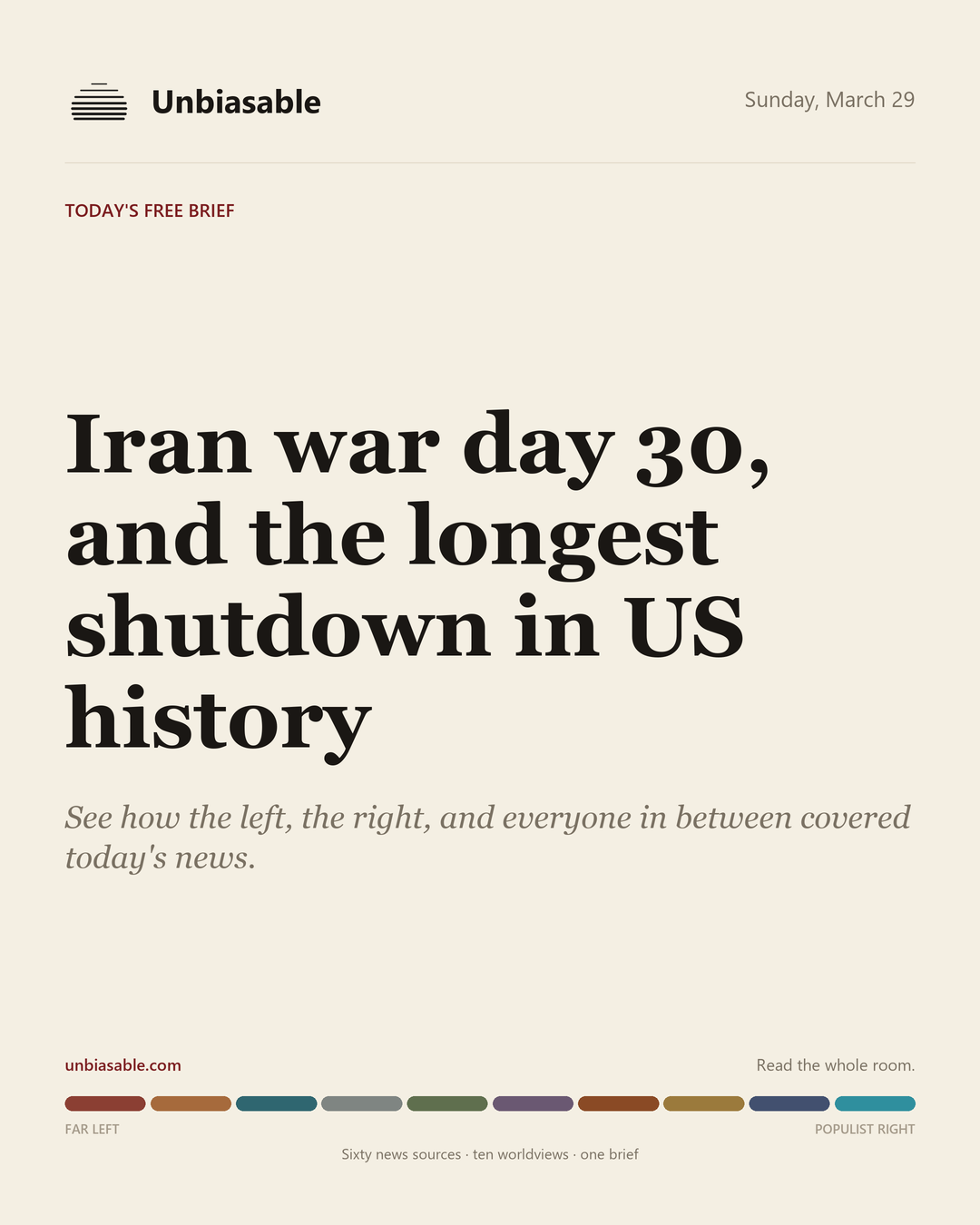
The Strait of Hormuz is allowing approximately 2 vessels per day versus the 100+ that transited before the war started; Iraq, Saudi Arabia, Kuwait, and UAE have collectively lost 10+ million barrels per day of output; and not a single source today named the diplomatic or military conditions under which the strait reopens. [58]›
The No Kings protests drew an estimated 8 million people across 3,300 locations, making them the largest single-day protests in modern US history by some estimates -- but the Communist/far-left spent its entire coverage criticizing Democratic Party politicians at the rallies for channeling mass opposition back toward the party that supports the Iran war. [6][13]›
Two US citizens -- Renée Good, shot January 7 by ICE agent Jonathan Ross, and Alex Pretti, an ICU nurse shot January 24 by CBP officers while filming agents in Minneapolis -- are the specific trigger for the DHS shutdown standoff that just became the longest partial government shutdown in US history, yet neither killing appears in today's MAGA or conservative coverage of that shutdown. [37]›
The Atlantic and The American Conservative both concluded today that the Iran war represents a strategic failure, though for incompatible reasons: The Atlantic frames it as Trump betraying his non-ideological populist coalition [34], while The American Conservative frames it as Israel successfully maneuvering the US into fighting its proxy war [60]. Two publications that agree on almost nothing landed in the same place.›
Lockheed Martin announced on March 25 a framework to quadruple Precision Strike Missile production capacity -- the same weapon the US fired at approximately half its combined inventory in the war's first 16 days -- while the Pentagon simultaneously requested an additional $200 billion in war funding on top of its $1 trillion annual budget. (Washington Times) [44]›
Story Comparisons: the same event, in each side’s words
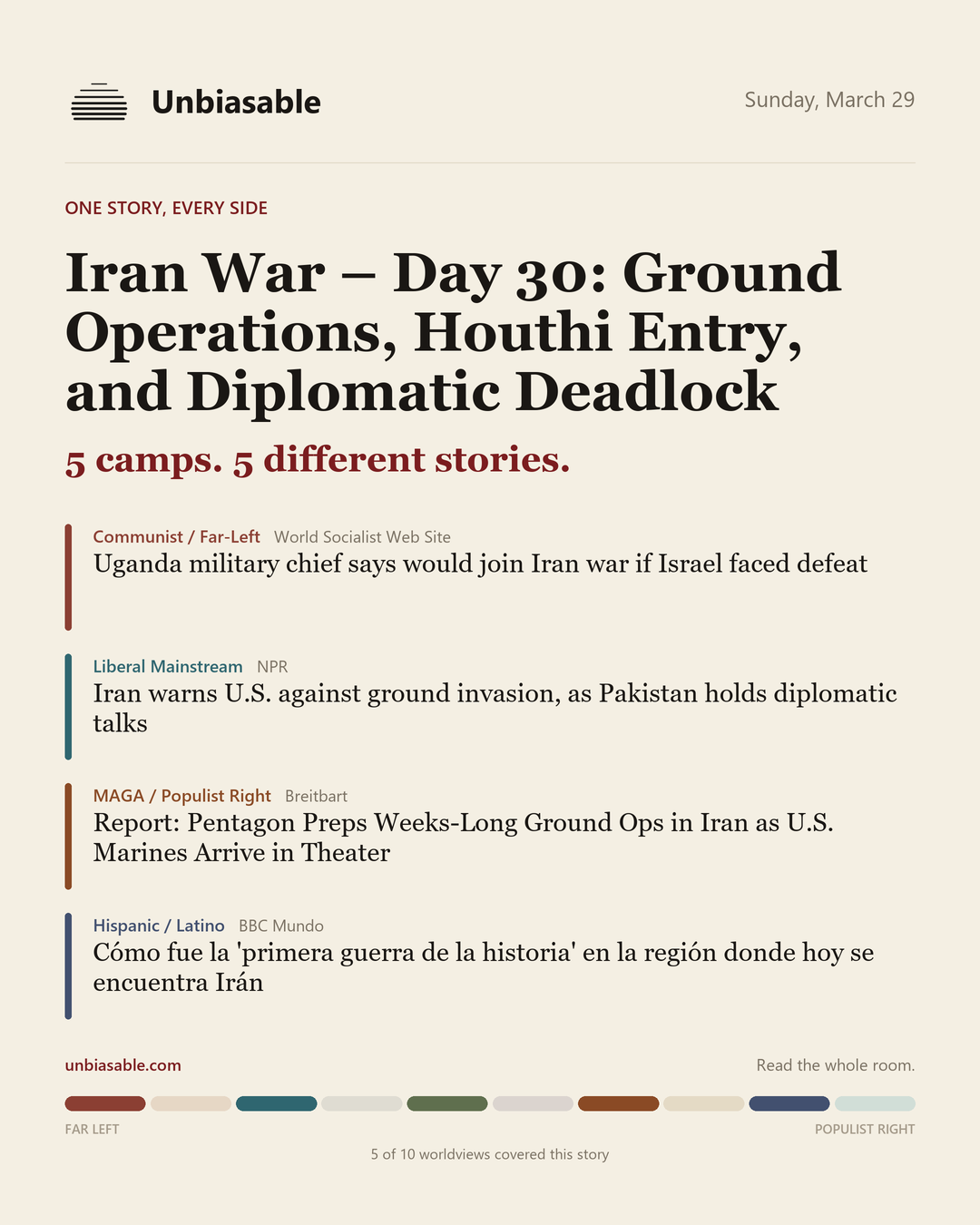
Iran War – Day 30: Ground Operations, Houthi Entry, and Diplomatic Deadlock
The US is 30 days into a war with no defined termination conditions, half its missile inventory already expended, and a peace counter-offer from Iran that would permanently transfer control of 20% of global petroleum supply.
5 source groups in today’s recordNo relevant coverage found from Democratic SocialistLibertarianReligious Right
How each side framed it
Far Left“Uganda military chief says would join Iran war if Israel faced defeat”World Socialist Web Site
“US imperialism”
WSWS framed Uganda's military loyalty statement as a window into global capitalist alignment with "US imperialism," situating the war within the structural logic of capitalist states protecting oil routes and geopolitical dominance "above all against China" [3]. The US-Israeli war is cast as driven by "strategic imperatives of US imperialism, the control over oil resources, critical trade routes" -- not by any Iranian nuclear threat. The WSWS article traced how rising fuel costs from the Hormuz blockade directly harm Ugandan workers and rural populations, making the analytical point that imperialism abroad and austerity at home are expressions of the same class policy [3].
Liberal“Iran warns U.S. against ground invasion, as Pakistan holds diplomatic talks”NPR
NPR treated the war as a diplomatic and security management problem. It centered the Pakistan mediation initiative as a potential off-ramp and foregrounded Iran's counter-proposal -- control of Hormuz plus reparations -- as the obstacle to resolution [24]. The article's causation runs: Iran's intransigence forces military escalation; diplomacy is the path out. The Pakistani, Saudi, Turkish, and Egyptian diplomatic effort was framed as a constructive multilateral initiative.
Liberal“The Kurdish Ground Force Preparing to Fight in Iran”The Atlantic
“on the trigger finger”
The Atlantic reported from inside PJAK mountain bases, documenting Kurdish fighters who say they are "on the trigger finger" and "have never been this busy" [33]. The article named a specific problem no other source addressed: PJAK is designated a US terrorist organization due to ties to PKK leader Abdullah Ocalan; the CIA "may already" be arming them per CNN reporting; deploying Kurds risks triggering Turkish retaliation and a civil war that could produce a refugee crisis exceeding Syria's. The Atlantic framing decided this was a ground operation with unacknowledged catastrophic strategic risks [33].
Center-Right“Client Tails Wag the U.S. Dog”The American Conservative
“made a concerted effort for years to drag the United States into an armed confrontation with Iran”
Ted Galen Carpenter explicitly named Israel as having "made a concerted effort for years to drag the United States into an armed confrontation with Iran" and having been "extraordinarily successful" [60]. The American Conservative described it as "blatant strategy" and "implicitly conced[ing] that a small client state had forced its hand" -- a characterization that would be controversial in any publication right of center. TAC's framing decided this was a cautionary case study in client-state manipulation, not a US strategic choice [60].
MAGA“Report: Pentagon Preps Weeks-Long Ground Ops in Iran as U.S. Marines Arrive in Theater”Breitbart
“Operation Epic Fury”
Breitbart covered the war as "Operation Epic Fury" with 11,000+ strikes "underscoring the scale of the campaign" -- a quantity treated as a measure of resolve [69]. Ground planning reflects "standard military preparation"; Iran is the obstacle to "freedom of navigation through the strategic waterway." No cost-benefit analysis appeared; Breitbart used the full military/government name for the operation throughout, treating it as legitimate state action rather than a contested policy choice.
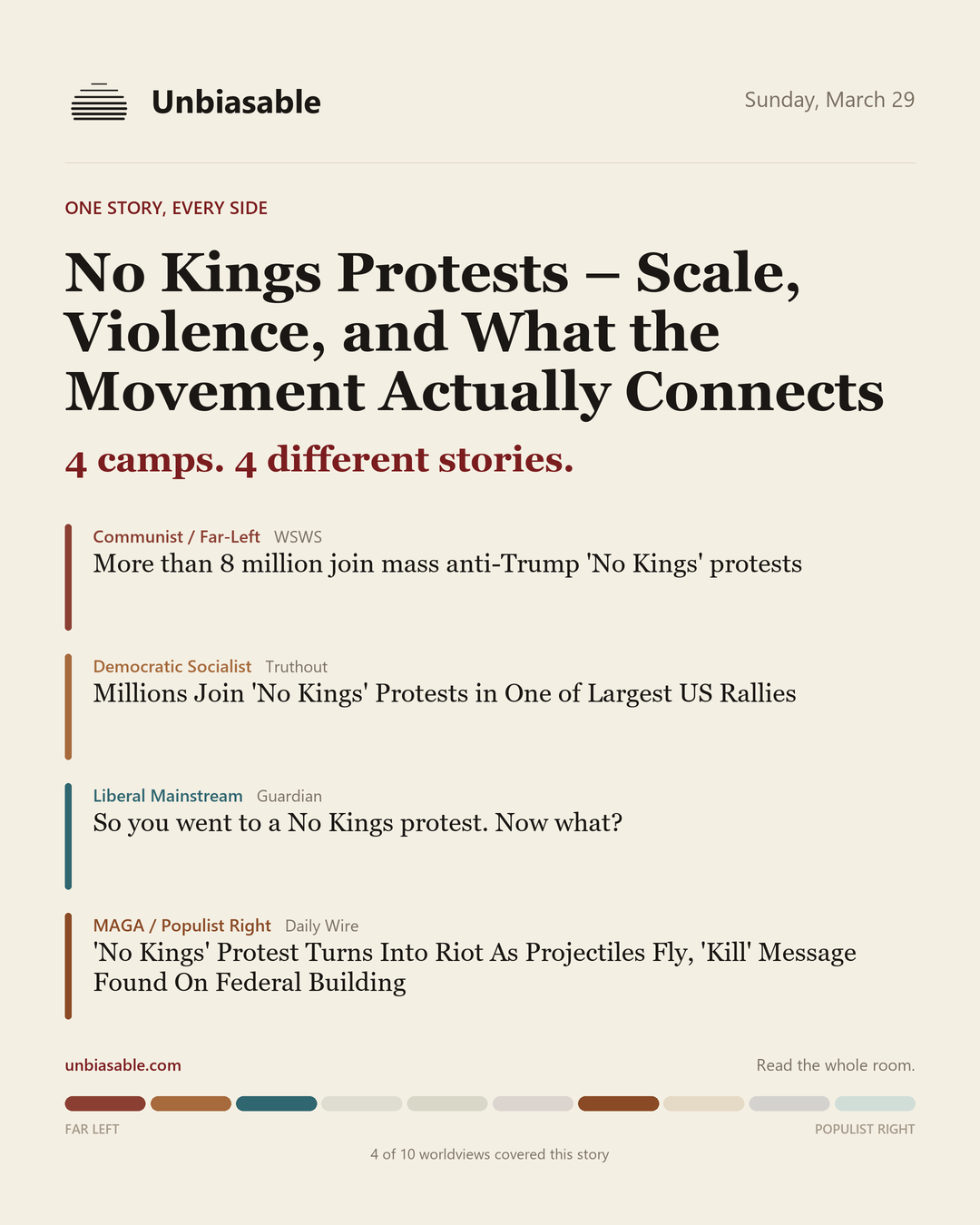
No Kings Protests – Scale, Violence, and What the Movement Actually Connects
Eight million people marched while their organizers suppressed the specific grievances that drove the crowds into the streets.
The facts1 point
01The Indivisible Project, the organizational backbone of No Kings, has received funding from George Soros's Open Society Foundations, including a $3 million two-year grant (OpenSecrets).
4 source groups in today’s recordNo relevant coverage found from EstablishmentLibertarianReligious RightIdentity
How each side framed it
Far Left“More than 8 million join mass anti-Trump 'No Kings' protests”WSWS
“non-partisan event”
WSWS validated the scale of the protests as evidence of organic working-class opposition while simultaneously condemning the event's organization. The article reported that SEP chairman David North was physically prevented from speaking at the Nuremberg solidarity rally because he intended to criticize the US war on Iran and the Democratic Party's support for it -- organizers told him it was a "non-partisan event" [6]. WSWS named Democratic politicians at the Minneapolis stage (Sanders, Walz, Ellison, Weingarten) as attempting "to channel mass opposition back behind the Democratic Party and the trade union bureaucracies" [6]. The WSWS frame: the movement is real; its leadership is captured.
Dem Soc“Millions Join 'No Kings' Protests in One of Largest US Rallies”Truthout
“No ICE, No wars”
Truthout covered the scale and notable speakers as a genuine democratic expression [13]. The article noted anti-war sentiment visible throughout the protests and treated "No ICE, No wars" as a significant competing chant -- showing that communities see immigration enforcement and the Iran war as connected [13]. Truthout's framing accepted the organizers' legitimacy that WSWS rejected.
MAGA“'No Kings' Protest Turns Into Riot As Projectiles Fly, 'Kill' Message Found On Federal Building”Daily Wire
“democracy in action”
The Daily Wire's coverage was defined entirely by the Los Angeles violence: graffiti threatening ICE agents, concrete blocks thrown at federal officers, LAPD tactical alert [100]. Mayor Karen Bass's description of protests as "democracy in action" was quoted as evidence of Democratic tolerance for violence. The article did not distinguish between the 8-million-person national event and the subset of protesters in one city who engaged in property destruction and assault.
Fox News (Sen. Mazie Hirono trolled) Fox News covered the protests primarily through a counterframing move: Senator Hirono's tweet reading "Donald Trump is not, never will be, and has never been a king" was presented as Republicans agreeing with her, framing the No Kings premise as self-defeating [92]. The coverage treated the entire protest as an exercise in Democratic self-contradiction.
Liberal“So you went to a No Kings protest. Now what?”Guardian
“No ICE, No wars”
The Guardian covered the protest as a movement-building question -- what converts one-day turnout into sustained organizing [40]. The article drew on movement scholars and historical precedents, treating the event as a potential inflection point. The framing assumed the protests were democratically legitimate and asked what comes next.
The Communist/far-left and MAGA/right agree on one thing: the No Kings movement is controlled by elites. WSWS identifies the controlling elites as the Democratic Party and trade union bureaucracies [6]; MAGA media identifies them as a Soros-backed network of 500 organizations with combined revenues of $3 billion. Both ideologies are structurally motivated to discredit the protest, and both have real evidence for their specific critiques.
The most significant absence in all coverage: the specific events that produced the "No ICE, No wars" chant -- the January 2026 killings of Renée Good and Alex Pretti, two US citizens killed by federal immigration agents in Minneapolis. These names are referenced only as a Bruce Springsteen song title in Truthout [13] and as a subordinate clause in WSWS [6]. The Daily Wire's coverage of LA violence [100] never asked why protesters were specifically targeting ICE, which would require naming why ICE is particularly hated in Minneapolis. The Guardian's "how to end this war" essay [43] treats the protest's anti-war energy without connecting it to the specific domestic incident that fused anti-war and anti-ICE sentiment into a single movement.
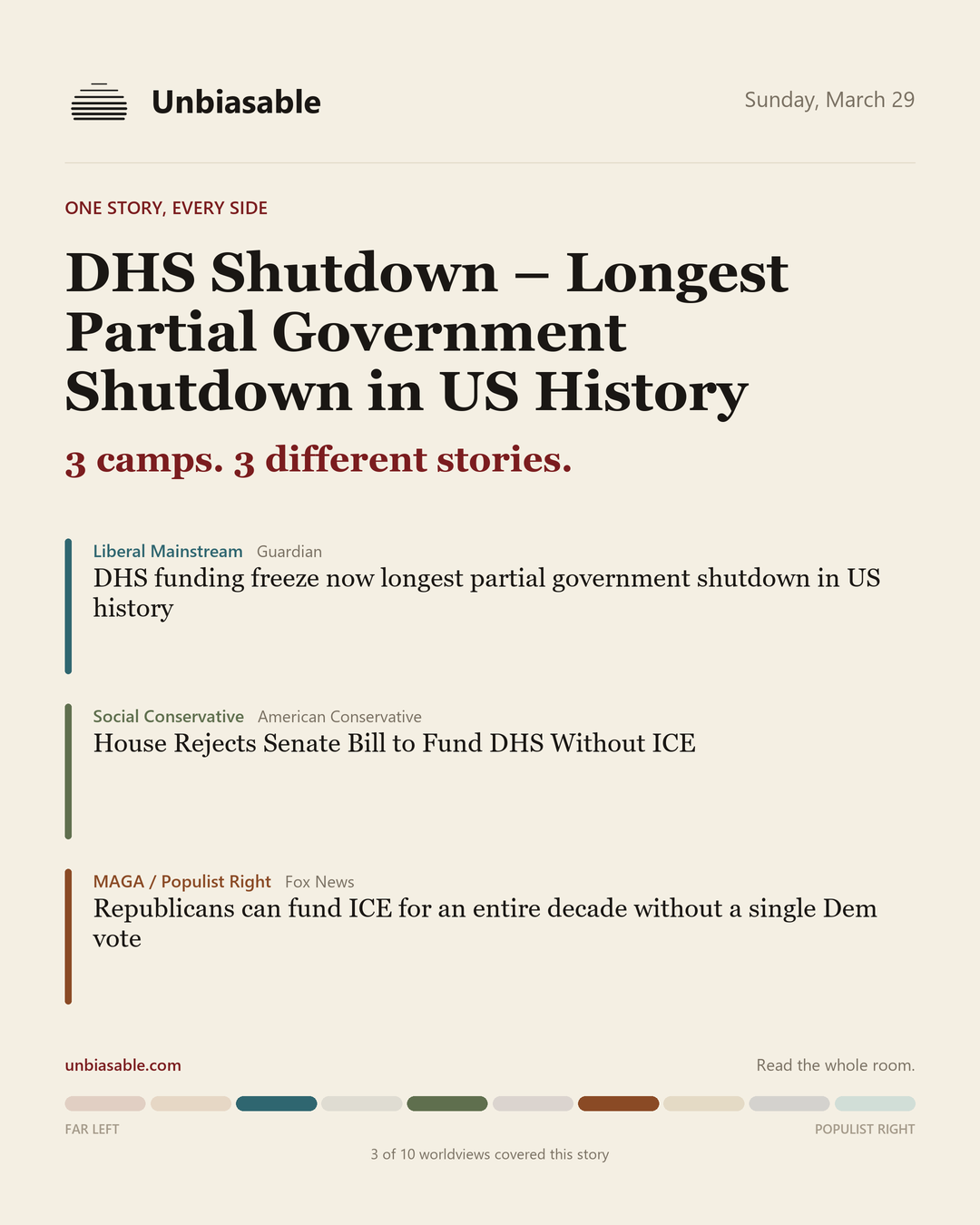
DHS Shutdown – Longest Partial Government Shutdown in US History
A 6-week standoff over ICE reform demands triggered by the killing of two US citizens is shutting down airport security before the FIFA World Cup.
3 source groups in today’s recordNo relevant coverage found from CommunistDemocratic SocialistLibertarianReligious RightIdentity
How each side framed it
Liberal“DHS funding freeze now longest partial government shutdown in US history”Guardian
“can't afford basic necessities like gas, child care, food or rent”
The Guardian's framing centered civilian harm: unpaid workers, airport delays, mothers unable to pay for child care, officers who "can't afford basic necessities like gas, child care, food or rent" [37]. The causal structure is institutional dysfunction -- neither side will move, workers and travelers pay the price. The article gave Homan's position fairly but treated it as one side in a standoff, not as the correct constitutional position.
Center-Right“House Rejects Senate Bill to Fund DHS Without ICE”American Conservative
The American Conservative covered the procedural facts without explicit editorializing: the Senate passed a bill, the House rejected it as inadequate, Johnson seeks full DHS funding [64]. The implicit framing is constitutional: law enforcement agencies should not be defunded because of disagreements over how they enforce existing law. The article did not address the specific ICE incidents that prompted the Democratic demands.
MAGA“Republicans can fund ICE for an entire decade without a single Dem vote”Fox News
“They're holding the department hostage because they don't like what ICE is doing”
Ted Cruz's framing, amplified by Fox, treats Democrats as pursuing operational policy goals through funding hostage-taking: "They're holding the department hostage because they don't like what ICE is doing" [93]. Tom Homan invoked precedent: "The same laws ICE follows today have been in place during Clinton, Obama, and now" [102]. The MAGA framing inverts the Guardian's cause-and-effect: not that ICE tactics created a crisis requiring reform, but that Democratic refusal to fund lawful enforcement created the crisis.
The operative blind spot shared by all three framings: the specific events that triggered Democratic reform demands -- the January 2026 killings of Renée Good and Alex Pretti in Minneapolis, two confirmed US citizens shot by federal immigration agents -- appear in none of today's DHS shutdown coverage from any ideological camp. Homan's Fox interview cited 10 operational reform demands as if they emerged from abstract Democratic anti-enforcement ideology rather than from two specific civilian deaths that Trump himself acknowledged should not have happened.
Church of the Holy Sepulchre – Palm Sunday Blocked, Pope Against War
For the first time in centuries, the highest Catholic authority in Jerusalem was barred from the site of Christ's crucifixion; the new Pope said God rejects the prayers of those who wage war.
The facts1 point
01The Latin Patriarchate stated this was "the first time in centuries" church leaders were prevented from celebrating Palm Sunday at the site [57][103][141].3 ideologies
4 source groups in today’s recordNo relevant coverage found from CommunistDemocratic SocialistLibertarianReligious Right
How each side framed it
Liberal“Pope Leo XIV rejects claims that God justifies war in Palm Sunday Mass message”NPR
“does not listen to the prayers of those who wage war”
NPR centered the Pope's homily as the story, treating Leo XIV's statement that God "does not listen to the prayers of those who wage war" as a political intervention in the Hegseth-inflected Christian nationalism surrounding the Iran war [22]. The blocked Palm Sunday Mass appeared as contextual detail supporting the Pope's larger anti-war message. NPR also noted Russia's Orthodox Church has similarly invoked holy war framing for Ukraine.
Center-Right“Israeli Police Block Latin Patriarch from Palm Sunday Mass”American Conservative
“unfortunate overreach”
The American Conservative treated the Holy Sepulchre incident as a religious freedom violation and a diplomatic problem, with the focus on the unprecedented nature of the restriction [57]. The article noted the Western Wall exemption -- private Jewish prayers permitted while Catholic public worship was blocked -- as raising questions about consistency. Huckabee's "unfortunate overreach" characterization was given prominence; he is explicitly pro-Israel, making his criticism notable [57].
MAGA“Israel Blocks Catholic Cardinal From Holy Site On Palm Sunday Over Safety Concerns”Daily Wire
The Daily Wire gave substantial weight to Israel's security justification: missile fragments from recent Iranian strikes landed near the church; the Old City lacks adequate emergency vehicle access; the restriction applied to all three Abrahamic faiths' sites [103]. The Daily Wire's framing decided this was a wartime security necessity, not a violation.
MAGA Coalition Fracturing – CPAC, Manosphere, and the 2028 Succession Question
The president who skipped CPAC to run his war is watching the coalition that reelected him fall apart over the same war.
2 source groups in today’s recordNo relevant coverage found from CommunistDemocratic SocialistLibertarianMAGAReligious RightIdentity
How each side framed it
Liberal“The Manosphere Turns on Trump”Atlantic
“full MAGA”
The Atlantic treated the manosphere's disenchantment as a structural coalition problem: these voters (Schulz's demographic -- non-ideological, anti-woke, economically frustrated males) were never "full MAGA" and their 2024 support was conditional on Trump being anti-establishment and anti-war, not on conservative governance [34]. The Atlantic quotes Schulz: Trump "blocked the release of the Epstein files. ICE murdered an American citizen in cold blood. He's funding the wars instead of ending them." The Iran war is framed as the final breach of an implicit contract.
Liberal“'It's biblical': MAGA anxiety over Iran war on display at CPAC”Guardian
The Guardian reported from CPAC's floor, documenting the competing arguments between pro-war figures (Grenell, former Navy SEALs) and skeptics (Prince, Gaetz) [46]. The Guardian centered the absence of resolution: without Trump in the room, no authoritative voice could settle the internal MAGA debate. The article noted the Florida seat flip as evidence that the political consequences of the war are already materializing.
Center-Right“Vance Wins CPAC 2028 Straw Poll, but Rubio Rises”American Conservative
The American Conservative read Rubio's rise from 3% to 35% as the Iran war's direct political consequence: Vance's foreign policy restraint brand is damaged by a war he did not publicly oppose, while Rubio, as Secretary of State, has been associated with active prosecution of the conflict [63]. The article named what neither liberal mainstream source explicitly named: the Iran war is reshaping the 2028 Republican nomination race in real time.
Unexpected alignmentboth The Atlantic (center-liberal) and The American Conservative (social conservative) identified the manosphere/restraint faction as a politically decisive constituency whose alienation from the war creates genuine electoral risk for Republicans. The Atlantic frames this as good news for Democrats; The American Conservative frames it as a succession opportunity for a more restrained Republican successor. Both are probably correct about the politics.
The takeaway
--
Birthright Citizenship at the Supreme Court
The Court that just struck down Trump's tariffs is about to rule on whether the 14th Amendment means what it has been understood to mean for 125 years.
2 source groups in today’s recordNo relevant coverage found from CommunistDemocratic SocialistEstablishmentLibertarianReligious RightIdentity
How each side framed it
Liberal“Some critics of birthright citizenship say it's a fraud issue. What does that mean?”NPR
NPR framed the case as a proportionality question: the birth tourism fraud problem is real but addressable through existing immigration law, making a constitutional revision disproportionate [27]. Expert sourcing leaned toward critics of the executive order. The article acknowledged the fraud problem is genuine while questioning whether this mechanism addresses it.
MAGA“Supreme Court prepares to review Trump executive order on birthright citizenship”Fox News
“fundamental constitutional question largely ignored for more than a century: Who qualifies as an American citizen?”
Fox News framed the case as the Court's opportunity to resolve a "fundamental constitutional question largely ignored for more than a century: Who qualifies as an American citizen?" [97]. The framing emphasizes the constitutional ambiguity rather than the human stakes of a ruling, treating the executive order as a legitimate interpretive exercise pending SCOTUS review.
The absent perspective today: neither Hispanic/Latino nor Black American media covered the birthright citizenship case, despite being the communities whose members would most directly face affected status in the event of a ruling supporting the executive order.
Lockheed Martin and the weapons production windfall: Lockheed announced a framework on March 25 to quadruple Precision Strike Missile production capacity -- the same weapon the US fired at approximately half the combined US military inventory in Operation Epic Fury's first 16 days (Washington Times, Cronkite News). RTX, BAE Systems, Boeing, Honeywell, L3Harris, and Northrop Grumman are party to a multi-company agreement to quadruple "Exquisite Class" weapons production as Trump revealed a secret 3-month production head start (WION). The DOD simultaneously requested $200 billion in additional war funding [44]. No source today quantified what these combined contracts are worth.›
DHS Secretary Mullin's financial entanglements: Markwayne Mullin holds shares in six companies with significant DHS contracts, including L3Harris, Microsoft, RTX, and VSE Corporation, collectively valued between $29 million and $97 million according to his 2024 financial disclosures [119]. His L3Harris position rose 65% since acquisition versus 13% for the broader market. He invested $2.8 million in 31 companies on December 29 -- including Chevron, the only major US oil company producing in Venezuela -- five days before Trump attacked Venezuela over US oil company terms, after which Chevron's stock surged [119]. He now oversees DHS contracts exceeding $190 billion annually [119].
Iran's Hormuz counter-proposal and the energy sovereignty stakes: Iran's counter-proposal to the US 15-point peace plan includes official Iranian control over the Strait of Hormuz [24]. The strait currently permits approximately 2 vessels per day versus 100+ before the war [58]. The Dallas Fed projects a sustained closure reduces global GDP by 2.9 percentage points annualized in Q2 2026 (Dallas Fed). Iranian control of Hormuz as a peace condition would represent a permanent transfer of pricing power over approximately 20% of global petroleum supply -- a consequence none of today's sources translated into long-term consumer energy cost implications.›
Uber's liability reform campaign: Uber has spent more than $30 million backing a California ballot initiative that would cap attorney fees at 25% of total crash settlement awards, timed to precede its $1.25 billion investment in Rivian robotaxis [10]. Consumer Watchdog reports the initiative "will effectively shift the financial burden of accident injuries onto victims themselves, the health care system, and taxpayer-funded programs." Opponents have assembled a $55 million war chest. Uber also spent $3 million backing a PAC supporting Governor Hochul's 2026 reelection in New York, where Hochul proposed a similar liability cap [10]. Not addressed in any source outside Jacobin.
The Illinois Restaurant Association used a parliamentary maneuver to freeze Chicago's tipped subminimum wage at $12.62/hr, reversing a 2023 ordinance the City Council had passed 36-10. The freeze passed 30-18, four votes short of the supermajority needed to override a mayoral veto that Mayor Brandon Johnson has promised. Jacobin named this as a lobbying industry victory, not a market-driven correction: restaurant licensing data shows 1,600+ new food establishments opened in Chicago since the One Fair Wage ordinance took effect, contradicting the industry's catastrophe narrative. A major Chicago labor fight covered nowhere outside democratic socialist media. [7]
Minneapolis students Zakariya and Boisey describe daily life under Operation Metro Surge: suspending after-school activities because ICE agents patrol near the Y, worrying about their mothers' commutes to work, watching two classmates get kidnapped by ICE a block from campus. Border Patrol deployed tear gas at Roosevelt High School. This ground-level account of what the DHS shutdown standoff means in the communities where it's playing out appears only in Jacobin. [11]
The DBNY campaign forced Easy Aerial -- whose drones are used by US Customs and Border Patrol at the US-Mexico border and by the Israeli military at the Israel-Gaza border -- to vacate the Brooklyn Navy Yard when its lease expires in May. The campaign links Gaza solidarity to domestic immigration enforcement through the same contractor. Covered only by Truthout. [17]
Following the traffic death of 18-year-old Israeli settler Yehuda Sherman, 200+ masked settlers attacked the Palestinian village of al-Funduqumiya, injuring 10 Palestinians. The article frames these attacks as explicit settler movement policy: retaliatory violence used to advance territorial expansion in the Homesh corridor. Not covered by MAGA, social conservative, liberal, or center sources. [18]
Corpus Christi's two main reservoirs are at 8.4% capacity; the city may enter a water emergency as early as May. One Exxon Mobil and Saudi Aramco plastics plant used just under 5 billion gallons of water in 2024; industrial facilities account for 50-60% of the city's total water use; the city has not asked any industrial facility to conserve water. A planned desalination plant collapsed due to cost increases driven by tariffs and inflation. [14]
Ted Galen Carpenter's analysis explicitly names Israel as having "made a concerted effort for years to drag the United States into an armed confrontation with Iran" and having been "extraordinarily successful." A right-of-center publication published what would be described as isolationist if it appeared in a left-wing outlet. The article names Taiwan and NATO's eastern members as similarly dangerous security clients. This framing of US foreign entanglements as client-state manipulation is otherwise confined to the far-left. [60]
TAC argues that anti-war conservatives should claim Vonnegut, Heller, and Dr. Strangelove as their heritage, arguing that the left's weak response to the Iran war reveals its anti-war tradition was more about opposing Trump than opposing war. A cultural argument for right-wing foreign policy restraint that cites Kurt Vonnegut in a conservative publication. [61]
A Florida judge applied Stand Your Ground to dismiss manslaughter charges against three Miami-Dade police officers who fired 200+ rounds in under 25 seconds during a traffic chase, killing UPS driver Frank Ordonez and union representative Richard Cutshaw. The judge credited the police's need to defend themselves against fleeing suspects, placing legal responsibility for the bystanders' deaths on the suspects. Covered only by Black American media. [117]
Chicago is close to a $27 million settlement after new body camera footage showed officers telling dispatchers "we weren't even chasing them" seconds after witnessing the crash, a supervising lieutenant instructing officers to deactivate body cameras, and officers whispering "that's why you don't chase" off-camera. The city had initially appealed a $10.2 million jury verdict and was granted a new trial; new evidence reversed that calculation. Covered only by Black American media. [129]
Atlanta Black Star covered the financial disclosures showing Markwayne Mullin's net worth grew from $9 million to potentially $97 million during his congressional tenure, including stock purchases in DHS contractors five days before Trump policy moves that boosted those stocks. The story about the new DHS Secretary's financial conflicts appears only in Black American media, despite being sourced to New York Times reporting. [119]
Uber has spent $30+ million on a California ballot initiative capping attorney fees in crash lawsuits, framed as consumer protection but structured to reduce crash victims' legal access -- timed before its $1.25 billion robotaxi investment with Rivian. Uber also spent $3 million on a Hochul reelection PAC while Hochul proposed a similar cap in New York. An explicit corporate lobbying campaign affecting consumer rights covered exclusively by democratic socialist media. [10]
CBN News covered the nationwide rebranding of César Chavez Day following New York Times reporting of sexual abuse allegations by the labor and civil rights leader against women and girls, including movement co-founder Dolores Huerta. California renamed the holiday "Farmworkers Day"; Minnesota ended it. CBN News is the only outlet among today's 18 sources to cover this story, which involves a major civil rights memorial undergoing a reckoning with its founder's alleged predatory conduct. [112]

 “Uganda military chief says would join Iran war if Israel faced defeat”
World Socialist Web Site
“Uganda military chief says would join Iran war if Israel faced defeat”
World Socialist Web Site
 “Iran warns U.S. against ground invasion, as Pakistan holds diplomatic talks”
NPR
“Iran warns U.S. against ground invasion, as Pakistan holds diplomatic talks”
NPR
 “The Kurdish Ground Force Preparing to Fight in Iran”
The Atlantic
“The Kurdish Ground Force Preparing to Fight in Iran”
The Atlantic

 “Report: Pentagon Preps Weeks-Long Ground Ops in Iran as U.S. Marines Arrive in Theater”
Breitbart
“Report: Pentagon Preps Weeks-Long Ground Ops in Iran as U.S. Marines Arrive in Theater”
Breitbart