Story Comparisons: the same event, in each side’s words
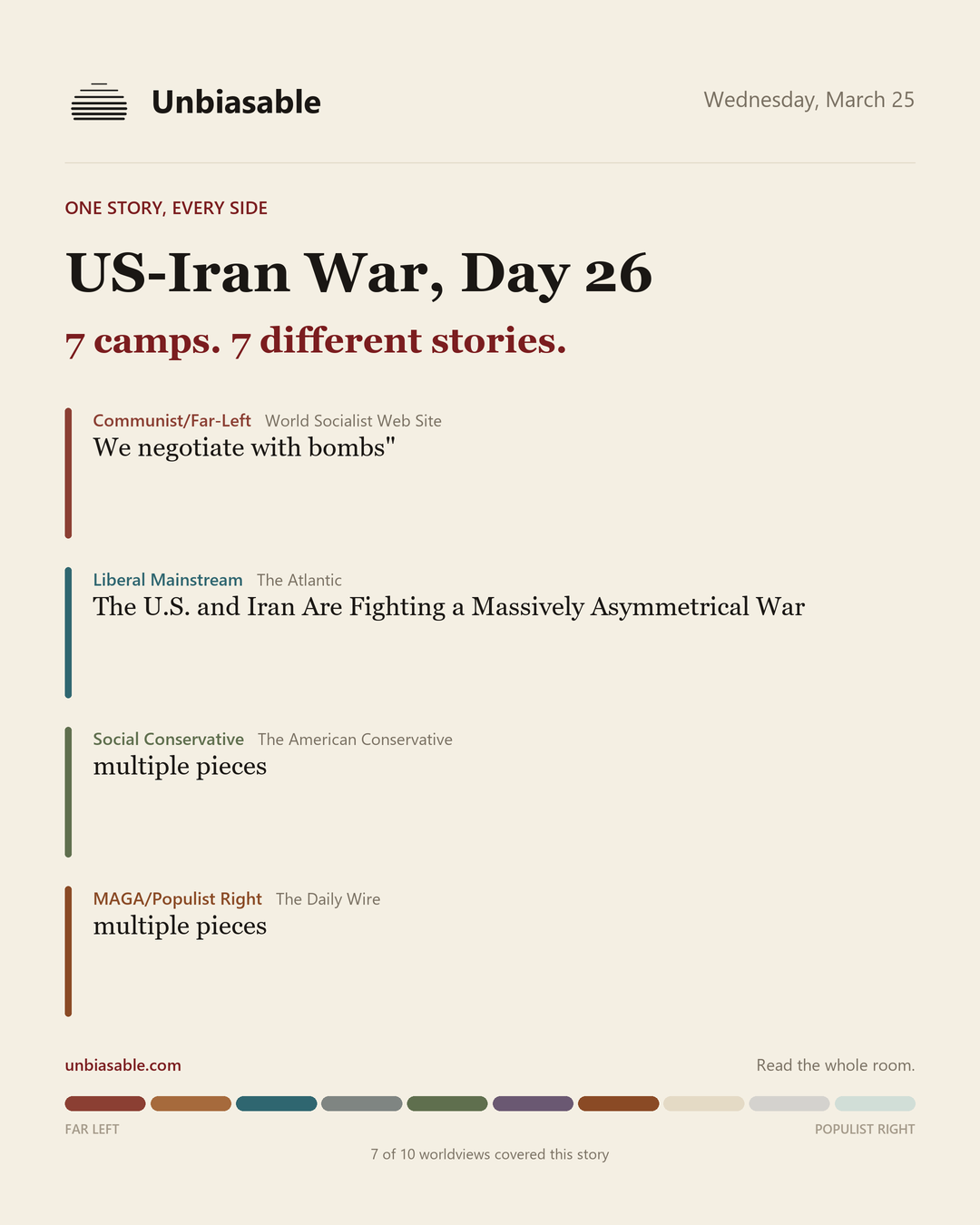
US-Iran War, Day 26
The facts1 point
01DISPUTED: WSWS reports 4,500 Marines and 1,000 82nd Airborne troops [19]; The American Conservative reports "approximately 10,000 additional troops in the region" [118]; The Daily Wire reports "3,000 troops" [215].3 ideologieseven opponents agreesources conflict
7 source groups in today’s recordNo relevant coverage found from Religious RightIdentity
How each side framed it
Far Left“"We negotiate with bombs": US moves to deploy 82nd Airborne to Iran”World Socialist Web Site
WSWS cast the deployment as imperialist escalation aimed at seizing control of Iran's energy sector, specifically Kharg Island and its oil export infrastructure [19]. Agency is assigned entirely to U.S. and Israeli state actors pursuing capitalist resource extraction under military cover. The headline quotation functions as an accusation of bad faith built into the story's title. WSWS also linked the war to a broader anti-socialist political project in the UK, arguing that anti-fascist movements are being used to channel working-class energy away from opposing the conflict [17].
Dem Soc“Trump's Iran War May Mark the Beginning of the End for Dollar-Backed US Empire”Truthout
Truthout economist Costas Lapavitsas framed the war as a symptom of U.S. imperial decline: a hegemon maintaining dollar dominance while losing real economic power [43]. Where WSWS frames the war as capitalist aggression succeeding, Truthout frames it as overreach that will hasten America's structural collapse. The causal story runs through global production chains and financial systems, not military hardware -- a different theory of imperialism pointing to the same conclusion.
Center“US expected to send thousands more soldiers to Middle East, sources say”r/centrist
“It's a war, it's not a war, it's a simple combat operation, we've won the war, we don't need allies, why aren't our allies helping us...”
Centrist community discussion focused on the administration's self-contradictions: "It's a war, it's not a war, it's a simple combat operation, we've won the war, we don't need allies, why aren't our allies helping us..." [79]. The dominant register was procedural frustration at incoherence, not ideological opposition. The JCPOA discussion [76] produced the strongest causal framing: "Iran was complying. Trump pulled out. Iran has zero reason to negotiate again" -- but subreddit rules constrained this into a question rather than an assertion.
Center-Right“multiple pieces”The American Conservative
“unpatriotic”
American Conservative produced the most internally complex coverage of any ideology today. Joe Kent resigned from the Trump administration over the war, framing it as a constitutional violation and a betrayal of veterans' warnings [115]. A separate piece named the 27% approval figure and argued Ben Shapiro is recycling David Frum's 2003 argument that Iraq War critics were "unpatriotic" -- now applied to Iran [119]. Another piece catalogued the fracturing of Trump's media support coalition [120] and named specific pro-war figures -- Lindsey Graham, Mark Levin, Laura Loomer -- as today's "handmaidens of war" [121]. This is not anti-war liberalism; it is anti-interventionist conservatism rooted in constitutional war powers and prudential foreign policy traditions. First Things [93] was more ambivalent, analyzing whether Trump would be forced to compromise after Iran struck a distant U.S./UK base, framing it as strategic management rather than moral failure.
Libertarian“The Iran War Has Already Hurt Oil Production More Than the '70s Energy Crisis Did”Reason.com
Reason centered the economic consequences with specific data: 11 million barrels/day production drop, exceeding 1973 and 1979 crises combined [122]. The framing treated Peter Navarro's claim that the war would lower energy prices as a falsified prediction -- a failed forecast the evidence now contradicts. Reason noted 90% of Americans expect higher gas prices [122], linking the war directly to Trump's economic promises and their outcomes.
Unexpected alignmentboth The American Conservative [119] and the Libertarian community [148] opposed the war, arriving at the same conclusion through different premises -- American Conservative through constitutional war powers and prudence; Libertarian through individual liberty, non-intervention, and the oil price data. Both also noted the gap between stated war aims and actual strategic clarity. What no covered outlet addressed: the Strait of Hormuz blockade's impact on U.S. allies in Asia (Japan, South Korea, Taiwan) who depend far more heavily on Gulf oil than the continental U.S.
The takeaway
The category split is: imperial resource seizure (WSWS), hegemonic overreach accelerating decline (Truthout), asymmetric economic warfare requiring strategic response (The Atlantic), procedurally incoherent executive action (r/centrist), unconstitutional overreach with no rationale (American Conservative), falsified economic prediction with measurable market costs (Reason), and Iran's stubborn rejection of a reasonable American offer (Daily Wire). The most significant convergence today is American Conservative and Libertarian opposition: they share the anti-interventionist conclusion while disagreeing on premises -- constitutional authority vs. market consequences. The most significant collective blind spot: the 73% of Americans who oppose the war appear in only one outlet [119] and then only as a polling figure, not as people with reasons. No covered outlet examined what strategic goal the U.S. has defined as or what conditions would end the conflict. ---
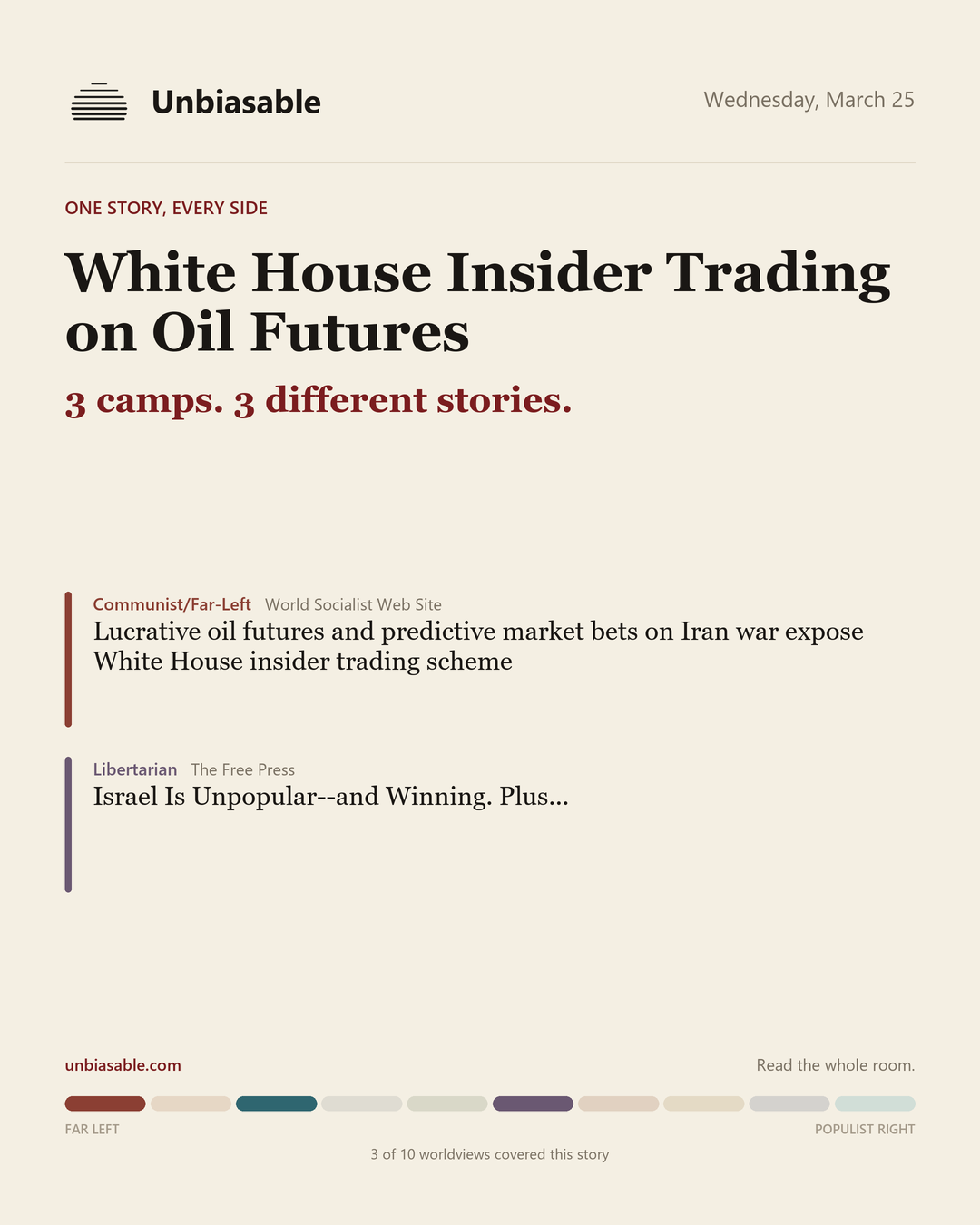
White House Insider Trading on Oil Futures
The facts1 point
01DISPUTED: WSWS reports "$580 million" [18]; The Free Press reports "exceeding $500 million" [158]; comments on r/politics separately cite "$1.5 billion in S&P 500 futures" placed at the same time [60].3 ideologiessources conflict
3 source groups in today’s recordNo relevant coverage found from Democratic SocialistCenterEstablishmentMAGAReligious RightIdentity
How each side framed it
Far Left“Lucrative oil futures and predictive market bets on Iran war expose White House insider trading scheme”World Socialist Web Site
“systematic financial exploitation of political decisions under Trump's presidency through advanced market timing and prediction platforms”
WSWS framed the trades as systematic -- "systematic financial exploitation of political decisions under Trump's presidency through advanced market timing and prediction platforms" [18], not an isolated act. The r/LateStageCapitalism community was more explicit: Both parties serve capital. This is the system [4]. Notably, the community post was explicitly stated as not to endorse Chris Murphy or the Democrats -- the scandal indicts the system, not the opposition party.
Liberal“Nobel laureate calls it "treason": $580 million traded minutes before Trump's oil reversal”r/politics
R/politics treated the pattern as a two-tiered justice story: "Martha Stewart went to prison for $45,000 in insider trading. $580 million traded minutes before a presidential announcement and a Nobel laureate is calling it treason. The two-tiered justice system has never been more visible" [60]. The framing is legal-institutional -- the problem is that rules aren't being applied equally, not that markets and politics are structurally entangled by design. The emotional intensity was high: the post received 32,355 upvotes [60].
Florida Special Election – Democrats Flip Mar-a-Lago District
3 source groups in today’s recordNo relevant coverage found from CommunistDemocratic SocialistLibertarianReligious RightIdentity
How each side framed it
Liberal“Democrats Flip Mar-a-Lago in Personal Humiliation for Trump”r/politics
“the double-digit blue shift comes after Trump won the district in 2024 by 11 points”
R/politics treated the result as the most politically significant story of the day, generating 27,626 upvotes on one post and 16,649 on another [61][62]. The dominant framing was historical momentum: "the double-digit blue shift comes after Trump won the district in 2024 by 11 points" [62]. Emphasis fell on Gregory's organizing ("went door to door through the entire district" [61]) and Trump's hypocrisy (voting by mail while opposing it). The emotional register was vindication. One comment flagged that this was the second same-night flip: the Senate district [62 comment]. R/democrats framed the win through Trump's personal vulnerability: "Democrats will now be competitive in places we never thought possible" [45].
Center“Democrat flips Republican-held Florida state House district that includes Trump’s Mar-a-Lago”r/centrist
“a swing district”
The centrist community noted the result with less emotional charge and some structural context: Palm Beach County is "a swing district" and this was a "special election so I'm interested to see eventual turnout" [77]. The mail-in hypocrisy was noted with humor rather than indignation. Some comments treated it as a harbinger, others as a single data point requiring context.
“Mid terms are going to be a blood bath. Trump better get a lot done in the next few months”
The r/Conservative community responded with midterm anxiety, not denial: "Mid terms are going to be a blood bath. Trump better get a lot done in the next few months" [104]. "It's pretty likely house or senate will flip" [104]. This is honest political risk assessment, not spin. The community frame is: this is a warning, act on it.
Unexpected alignmentboth r/politics community sentiment [61 comment] and r/Conservative [104] concluded Trump's coalition is in electoral trouble, though they differ on what follows.
The takeaway
--
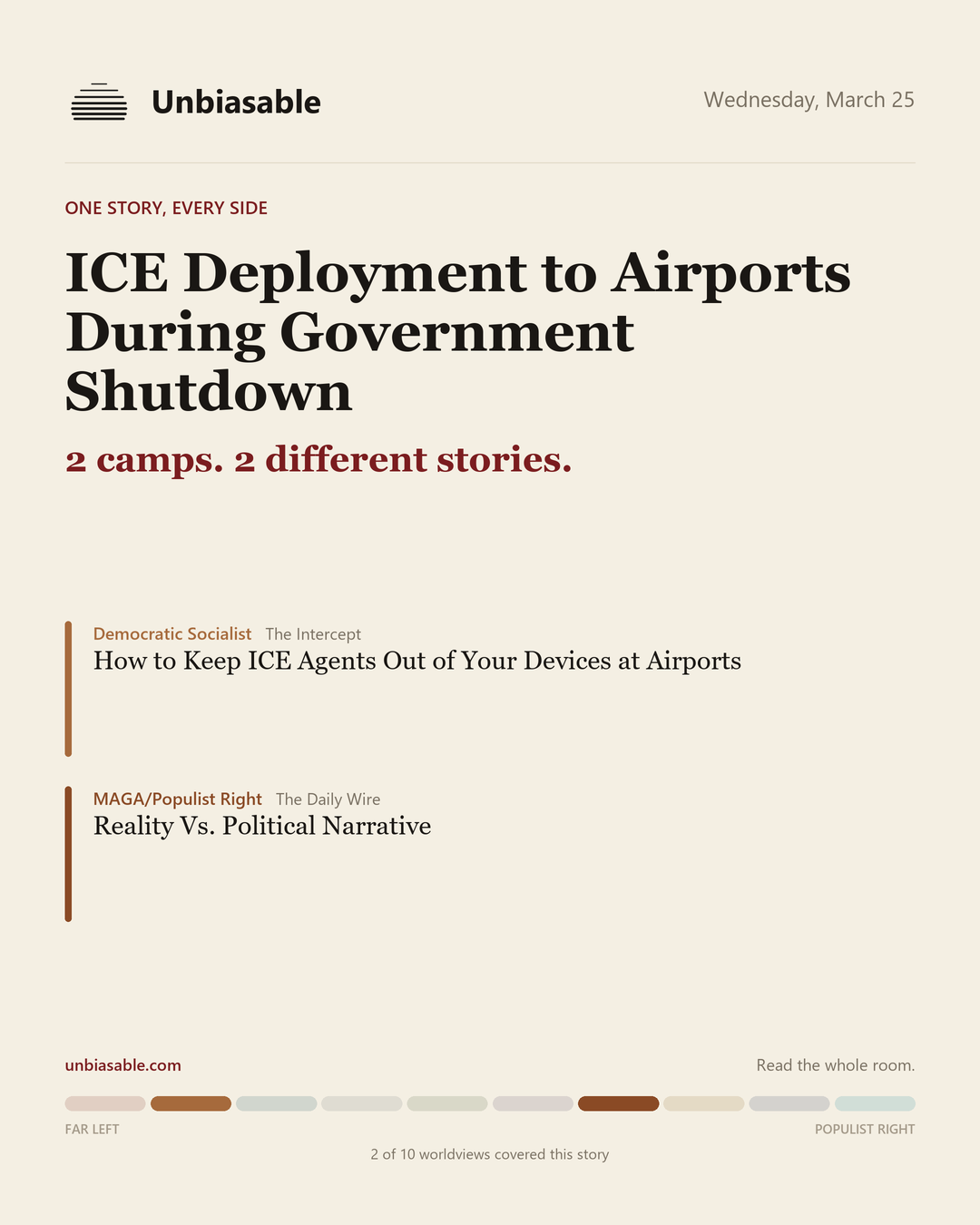
ICE Deployment to Airports During Government Shutdown
2 source groups in today’s recordNo relevant coverage found from CommunistLiberal MainstreamCenterEstablishmentLibertarianReligious RightIdentity
How each side framed it
Dem Soc“How to Keep ICE Agents Out of Your Devices at Airports”The Intercept
The Intercept shifted from news coverage to active reader guidance: how travelers should protect their digital data from ICE search [40]. The framing treats ICE agents as a civil liberties threat to all travelers, evidenced by the Norwegian tourist case (barred over a phone meme) and the airport detention of a mother [40]. The article's form -- a how-to guide -- implies readers are potential targets, not observers.
MAGA“Reality Vs. Political Narrative: Daily Wire Goes To The Front Lines Of ICE At Airports”The Daily Wire
“Reality Vs. Political Narrative”
The Daily Wire sent reporters to Houston specifically to document ICE agents assisting travelers [202]. The headline structure ("Reality Vs. Political Narrative") positions the Daily Wire as epistemically superior to other media: they went; others speculated. The article acknowledged Atlanta protests without investigating their content. The frame is not just ICE is fine but media claims about ICE are false.
MAGA“Democrats Continue Holding American Air Travelers Hostage To Save Illegal Aliens”The Federalist
The Federalist assigned causal blame explicitly: the shutdown is a Democratic instrument to protect illegal immigrants at travelers' expense [222]. Agency is entirely Democratic. ICE deployment appears as a reasonable government response to a manufactured crisis, not as a substantive immigration enforcement choice.
MAGA“Trump's just rage baiting them at this point 😭”r/trump
R/trump community treated the dynamic as Trump outmaneuvering Democrats: "They thought they were undermining his administration by refusing funding for DHS but they didn't see that he was just going to send ICE to the airport" [192]. The frame is strategic, not ideological: Trump wins, Democrats lose.
Unexpected alignmentThe Intercept (civil liberties threat) and The Federalist (Democratic hostage-taking) both treated the deployment as a political instrument rather than a transportation safety measure -- with opposite assignments of who wields it as a weapon.
The takeaway
--
U.S.-Ecuador Joint Military Operation – Dairy Farm Bombing
2 source groups in today’s recordNo relevant coverage found from CommunistCenterEstablishmentLibertarianMAGAReligious RightIdentity
How each side framed it
Dem Soc“Farmers Describe Torture From US-Ecuadorian Joint Military Operation”Truthout
“Operation Total Extermination”
Truthout centered victim accounts and placed the operation within the Trump administration's "Operation Total Extermination" framework, emphasizing 160 deaths and torture allegations [41]. The framing connects the local incident to U.S. military involvement operating under narco-trafficking interdiction as cover for a broader campaign of regional violence. The article's use of the administration's own operation name -- "Total Extermination" -- treats the label itself as evidence of the operation's character.
Liberal“The U.S. Said It Helped Bomb a Drug Camp. It Was a Dairy Farm.”r/neoliberal
The r/neoliberal community shared a New York Times investigation [56] with comments appalled at government dishonesty: This appalls me to my core. No one will bother looking into this [56 comment]. A community observation: There's a reason the US has in the past never publicly acknowledged these types of South America operations despite having been doing them constantly for the past 40 years [56 comment]. This frames the incident not as a new deviation but as exposure of a longstanding bipartisan practice -- a critique that is harder on the U.S. government than on Trump specifically.
The near-total absence of coverage from seven other ideological camps -- including the Libertarian outlets that covered Afghan ally death in ICE custody [123] and Section 230 threats -- is itself the most significant fact about this story.
2 source groups in today’s recordNo relevant coverage found from CommunistLiberal MainstreamEstablishmentLibertarianMAGAReligious RightIdentity
How each side framed it
Dem Soc“Pentagon Revises Restrictions on Journalists -- by Essentially Kicking Them Out”Truthout
“retains the core constitutional violation”
Truthout emphasized that the new policy "retains the core constitutional violation" despite the court ruling, and that press unions called it a violation of the judicial order [42]. The framing casts the DoD response as executive defiance of judicial oversight -- a constitutional separation of powers story, not merely a press freedom story.
Center“Pentagon will remove media offices after judge reinstates New York Times press credentials”r/centrist
“fill the pools with concrete”
The centrist community applied the "fill the pools with concrete" analogy: comply with the letter of a court ruling while defeating its purpose [78]. Comments focused on Hegseth's ego and the duration of the prior institutional arrangement: "After how many decades of those offices being there?" [78]. The framing is norm violation rather than constitutional crisis. What specific information journalists can no longer obtain -- and whether this affects coverage of the ongoing Iran war -- was not the community's central concern.
Only Libertarian media treated the death of a former Afghan Special Forces soldier in ICE custody as a significant accountability story, noting officers failed to provide his required inhaler and that ICE falsely alleged SNAP fraud against a man with documented military service [123].
Only Social Conservative media named the specific rhetorical move: Ben Shapiro recycling David Frum's 2003 charge that Iraq War critics were unpatriotic, now applied to Iran War opponents, with the historical lineage made explicit and the 27% approval figure cited [119].
Only Social Conservative media documented the internal fracturing of Trump's media coalition over the Iran war as a structural phenomenon, noting that the most skeptical faction within the coalition now holds "disproportionate influence during the critical election period" [120].
The 160 deaths and torture allegations from "Operation Total Extermination" in Ecuador received zero MAGA coverage despite involving active U.S. military operations -- only Democratic Socialist media treated civilian harm in a U.S.-backed operation as a story worth naming [41].
A DSA-backed candidate polling at 14% in the Wisconsin Democratic gubernatorial primary -- the community treated this as a meaningful left challenge to the Democratic establishment with potential national implications [27].
Only Democratic Socialist community spaces covered DoorDash deploying gig workers to perform micro-tasks that train the AI systems designed to replace them -- a concrete labor displacement story with no equivalent coverage elsewhere [36].
Only MAGA media treated an EEOC finding against Planned Parenthood for allegedly segregating employees by race and denying time-off benefits to white staff as front-page news [221] -- revealing how the EEOC's recent expansion of civil rights coverage to white employees functions as a MAGA-specific story category.
Only MAGA media framed Howard University's women's basketball team remaining in the locker room during the national anthem as a disciplinary and cultural loyalty story rather than an athlete expression story [206].
Only Libertarian media framed New Mexico's $375M verdict against Meta as a Section 230 and internet governance threat, arguing it allows states to reshape digital speech under child safety framing [125] -- every other camp either ignored it or would have covered it as a child protection win.
Only Center community spaces treated the administration paying $1 billion in public funds to stop a French company from building clean energy as an obvious waste of public money: "We're paying 1 BILLION dollars to get this French Energy company to walk away from leases that would have been used to create alternative energy" [84].
Only Center community spaces covered Judge Tanya Chutkan's ruling that Musk must face a lawsuit for exercising power without Senate confirmation, calling the government's defense "disquieting" [87] -- a constitutional accountability story that appeared in neither MAGA nor left-wing editorial coverage today.
Only Democratic Socialist media named the structural mechanism: Republicans tied airport security funding to immigration enforcement in the Homeland Security Appropriations bill, creating a forced choice that makes shifting money between agencies "extremely difficult" by design [21] -- framing the shutdown not as a political impasse but as an engineered structural constraint.
Only Communist/Far-Left community spaces covered Lula's CELAC-Africa forum speech on critical mineral extraction as neo-colonialism [5] -- a significant diplomatic statement at an international summit that received no coverage in any other ideological space, including Latin American sources.
Democratic Socialist
“Zohran and Department of Consumer and Worker Protection commissioner announcing that nearly $2 million is being returned to over 800 workers at Taco Bell, Dunkin, and Theory”
Reddit: r/DemocraticSocialism
Only Democratic Socialist community spaces treated a local government labor enforcement action -- wage recovery for 800 workers -- as a significant news story, with community enthusiasm centered on the novelty of government acting in workers' interests [25].
Only MAGA media published a piece explicitly arguing that legal immigration does not ensure assimilation and that multicultural policies have "failed to create social cohesion" [223] -- a position that distinguishes MAGA's immigration critique from the legal/illegal binary that even many conservatives use, revealing the movement's underlying concern with cultural rather than procedural immigration questions.

 “"We negotiate with bombs": US moves to deploy 82nd Airborne to Iran”
World Socialist Web Site
“"We negotiate with bombs": US moves to deploy 82nd Airborne to Iran”
World Socialist Web Site


 “US expected to send thousands more soldiers to Middle East, sources say”
r/centrist
“US expected to send thousands more soldiers to Middle East, sources say”
r/centrist