Story Comparisons: the same event, in each side’s words
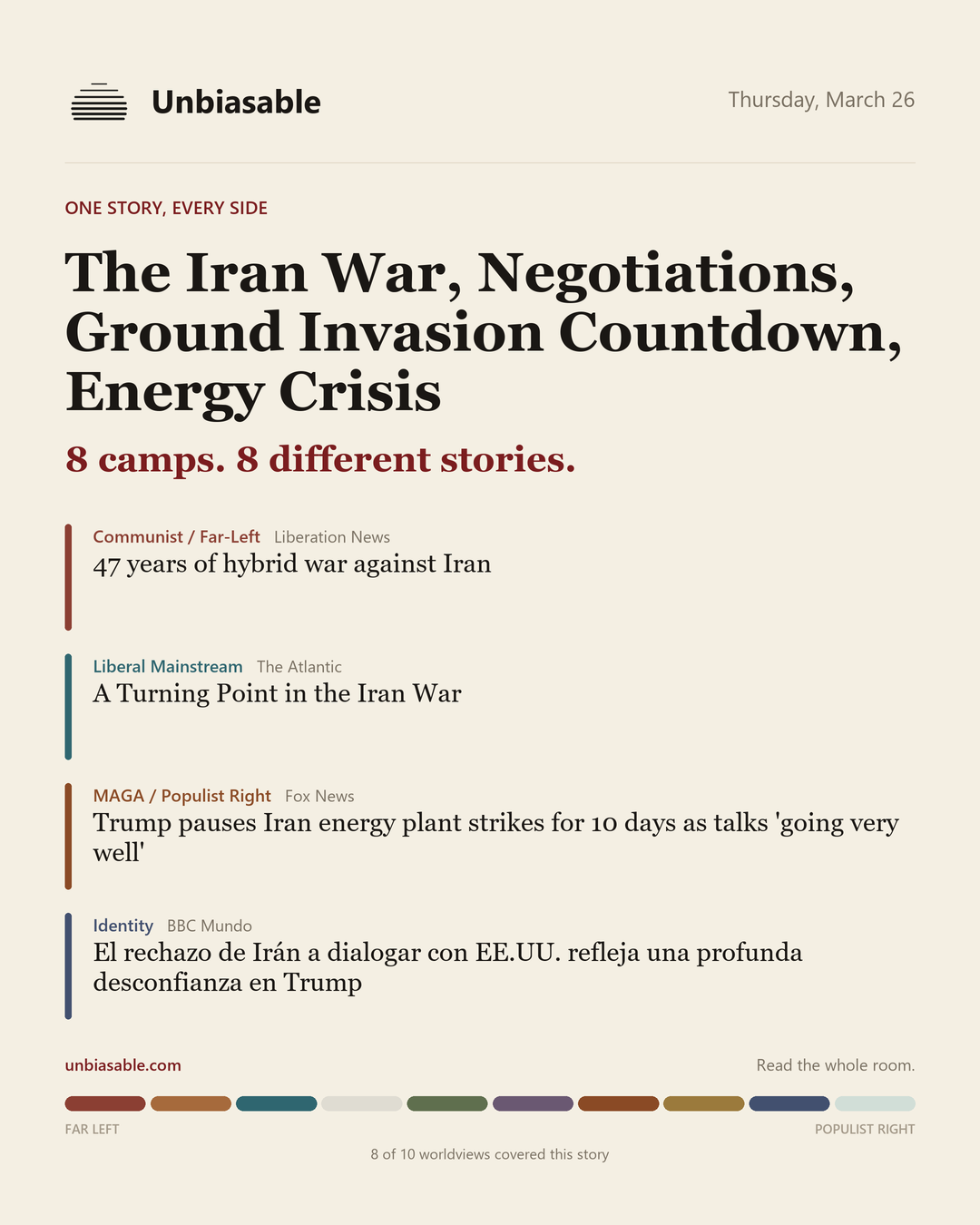
The Iran War, Negotiations, Ground Invasion Countdown, Energy Crisis
The facts1 point
01DISPUTED: Trump says Iran is "begging to make a deal"; Iran's state television broadcast "The end of the war will occur when Iran decides it should end" [167].sources conflict
8 source groups in today’s recordNo relevant coverage found from Center
How each side framed it
Far Left“47 years of hybrid war against Iran”Liberation News, WSWS
“hybrid war”
: Frames the war as the latest phase of a 47-year "hybrid war" rooted in US imperialism's effort to reverse the 1979 revolution and restore control over Iranian oil fields and the Strait [3]. The state is not failing in Iran; it is doing exactly what it is built to do. Costs, THAAD radar at $500 million each, interceptors at $13-15 million each, are catalogued as proof of "waste at an unimaginable scale, burning human lives and money away at a rate of millions of dollars per second" that could fund social programs [5]. False flag warnings about Iranian drone attacks on California are treated as a COINTELPRO-style playbook to expand domestic militarization [7]. The WSWS calls the "No Kings" protests necessary but insufficient: "Opposition to the escalating war against Iran must be placed at the center of opposition to the Trump regime" and links the ICE killings of Renee Good and Alex Pretti to what Steve Bannon allegedly described as a "test run" for 2026 election intimidation [30].
Dem Soc“Iran War Exposes the Energy Dominance Lie”Truthdig, Jacobin
“Energy Dominance Lie”
: Tracks the war's domestic political economy rather than its battlefield. Truthdig's "Energy Dominance Lie" traces how Trump's war contradicts his own stated energy independence rationale, the Strait closure has damaged the very energy markets the strategy claimed to liberate [60]. Allies are absorbing billions in costs for a war they were not consulted on, while US companies face supply disruptions [68]. The Jacobin story on Pentagon AI gatekeeper Emil Michael's Perplexity AI stake [51], alongside NPR's reporting on Claude being used in Project Maven targeting [105], frames AI in warfare as a corruption story, not just an ethics one: financial conflicts, not only military doctrine, are steering what AI is permitted to do in a live war.
Liberal“The Countdown to a Ground War”The Atlantic, NPR
“Countdown to a Ground War”
: The most granular factual reporting. The Atlantic's "Countdown to a Ground War" maps the actual negotiating positions: the US demands Iran dismantle its enrichment infrastructure, sever proxies, and accept military limits; Iran demands reparations, binding non-attack guarantees, and formal Strait sovereignty [113]. These positions have not moved. The IRGC now dominates Iranian deliberations "to a degree unprecedented even under Khamenei" [113]. The Atlantic's NATO piece documents European fury: a senior EU diplomat called Trump's request for help reopening the Strait the moment he "made NATO defunct in practice already" [116]. France deployed warships; Britain reluctantly permitted base access; no one has signed up for tanker escort duty. NPR's Fresh Air interview introduced Claude's role in Project Maven and the girls' school strike on day one of the war as a case study in AI accountability gaps [105].
Center-Right“Iran War Enters 27th Day: Iran Rejects Ceasefire, Suspects Island Invasion”The American Conservative, National Review
“cannot in fact rule the world purely by force”
: The sharpest internal disagreement in any ideological camp today. The American Conservative ran two pieces in direct opposition to each other: one updating the war's daily facts neutrally [155], and another explicitly arguing the US "cannot in fact rule the world purely by force" and that the war is a Suez-style strategic overreach from which no amount of continued fighting will extract a victory [156]. A third piece argues Russia's support for Iran is straightforward payback for US support of Ukraine, and the real surprise would be if Moscow had not responded this way [157]. National Review, by contrast, publishes war successes "they don't want you to hear about" [154], the sole enthusiastic right-wing defense of the military campaign. The American Conservative's anti-war stance is notable: it aligns its conclusion with the Communist left while arriving there through prudential conservatism and the costs to US readiness in other theaters, not anti-imperialism.
Libertarian“How Will Congress Fund a $300 Billion War With Iran?”Reason
“TACO”
: Pure fiscal analysis and anti-escalation. The $300 billion war funding question is framed as a constitutional and fiscal discipline test: even constitutionally legitimate war spending must be offset, and Congress has never done that since 1991 [162]. Reason's "TACO" analysis documents Trump's pattern of escalating threats and backing down at diminishing returns, and argues the Iran war breaks that pattern because Trump cannot control its pace and the economic damage has moved "beyond investor panic into the world of physical shortages" [167]. The "Forever War" framing places Iran alongside Iraq and Afghanistan as a structural failure of US foreign policy rather than a policy error [175].
MAGA“Trump pauses Iran energy plant strikes for 10 days as talks ‘going very well’”Fox News
“present”
: Defensive reporting. The emphasis is on Trump's active management, the pause, the talks, the "present" from Iran (10 oil tankers transiting the Strait), rather than the war's costs [228][236]. Fox's own poll showing a majority of Americans oppose the Iran strikes appeared in its coverage [232], an unusual moment of unfavorable data surfacing. The framing attributes public skepticism to the Democratic-media complex rather than to the war's actual trajectory.
Religious“A Daughter Killed for Freedom, a Mother Reborn in Jesus: 'I Feel a Deep Peace Because of Christ'”CBN
“I am very grateful to President Trump and Netanyahu. I always pray for them”
: The war as spiritual event. CBN's reporting centers on Iranians converting to Christianity after escaping regime violence [274][286][288], treats the war as the mechanism for Iran's spiritual chains breaking, and quotes an Iranian Christian exile: "I am very grateful to President Trump and Netanyahu. I always pray for them" [288]. White House framing, Iran is "desperate," "defeated militarily", is relayed without skepticism [278]. The IRGC naval chief's assassination and Israel's expansion into Lebanon are reported as tactical victories. The analytical category is not geopolitics; it is spiritual warfare with a favorable eschatological trajectory.
Missing from all 24 sources we read todaythe civilian casualty count inside Iran, and any accounting of what governance would look like in a post-regime Iran.
The takeaway
--
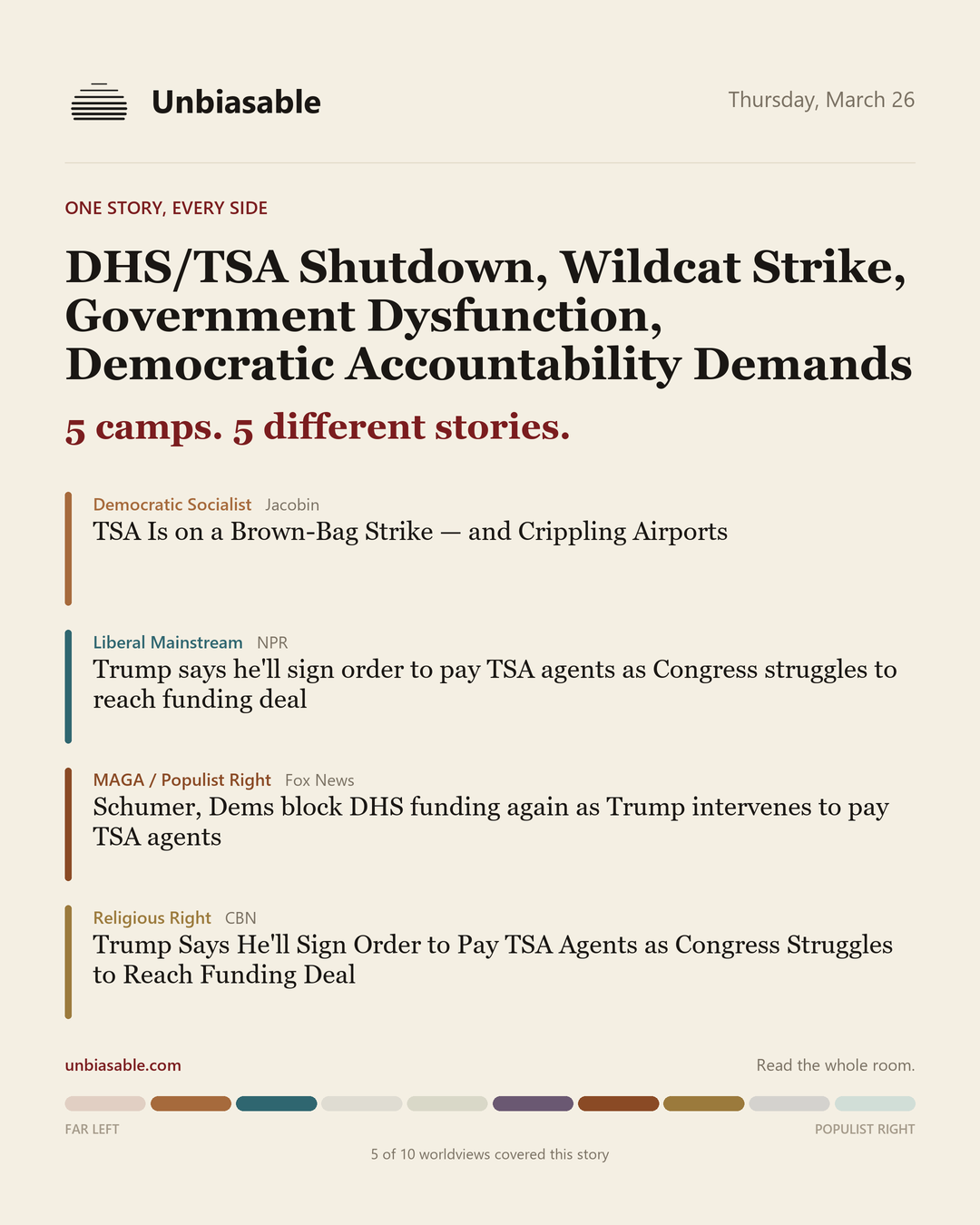
DHS/TSA Shutdown, Wildcat Strike, Government Dysfunction, Democratic Accountability Demands
5 source groups in today’s recordNo relevant coverage found from CommunistEstablishmentIdentity
How each side framed it
Dem Soc“TSA Is on a Brown-Bag Strike — and Crippling Airports”Jacobin
“brown-bag strike”
: The TSA callout wave is a "brown-bag strike", a de facto wildcat action by workers exploiting the plausible deniability of calling in sick, analogous to public-sector strikes of the 1960s-70s that won federal workers collective bargaining rights [54]. The framing centers worker agency: TSA agents are not merely victims of Congress; they are making a political choice with real consequences. Federal law prohibiting public-sector strikes is named as an injustice rather than a constraint. The shutdown is a labor story that liberal media keeps framing as a political one.
Liberal“Trump has deployed ICE agents to the nation's airports. What's their role?”NPR, The Guardian
“separately and extravagantly funded”
: Institutional crisis and consumer harm. NPR's reporting traces the ICE-at-airports development with unusual care: ICE is "separately and extravagantly funded" at $75 billion while TSA goes unpaid, creating a structural asymmetry that transforms the shutdown's meaning [103]. The Guardian foregrounds passenger testimony, flights missed, trips canceled, $600 rebooking fees, and quotes a Connecticut traveler directly calling it "a shameless, insensitive policy by an uncaring regime" [138]. NPR's private-security story notes 20 airports with contracted screeners have sub-10-minute wait times, raising the privatization question without advocating for it [102].
Libertarian“I Spent Over 3 Hours in a TSA Line. Why Haven't We Abolished This Agency?”Reason
: The shutdown is evidence for abolishing the TSA entirely. The author's three-hour personal account at New Orleans cites the 2015 DHS investigation finding TSA's 95% failure rate on mock weapon detection [163]. Reason's structural critique names the root problem as federal management of what could be a privately-contracted service: 100 countries use user-funded utilities for air traffic control without shutdown vulnerability; most airports in Canada and Europe use private screeners [166]. The shutdown's cause, Democratic immigration demands, is acknowledged, but the Libertarian frame shifts quickly to the underlying dysfunction: "a government shutdown caused by unserious immigration enforcement creates TSA backups that could have been easily avoided if not for two decades of unserious federal airport security policy" [166].
MAGA“Schumer, Dems block DHS funding again as Trump intervenes to pay TSA agents”Fox News
“ON THE SIDE OF CRIMINAL ILLEGAL ALIENS, AND NOT THE AMERICAN PEOPLE”
: Democrats are fully responsible. Trump's quote is relayed approvingly: Democrats stand "ON THE SIDE OF CRIMINAL ILLEGAL ALIENS, AND NOT THE AMERICAN PEOPLE" [222]. Trump's executive order is framed as heroic unilateralism against obstruction. The deaths of Renee Good and Alex Pretti, the events that precipitated the Democratic demands, do not appear in Fox's coverage of this story. The ICE deployment to airports is framed as security assistance, not as a politicization of transportation infrastructure.
Unexpected convergence: Both Reason (libertarian) and Jacobin (democratic socialist) criticize the underlying structure of TSA, the former for privatization's effectiveness, the latter for its failure to grant workers collective bargaining rights. Both reach the system is broken from opposite ends of the political spectrum. The partisan disagreement about who broke it this time is largely orthogonal to that shared structural critique.
3 source groups in today’s recordNo relevant coverage found from CommunistDemocratic SocialistCenterEstablishmentLibertarianReligious Right
How each side framed it
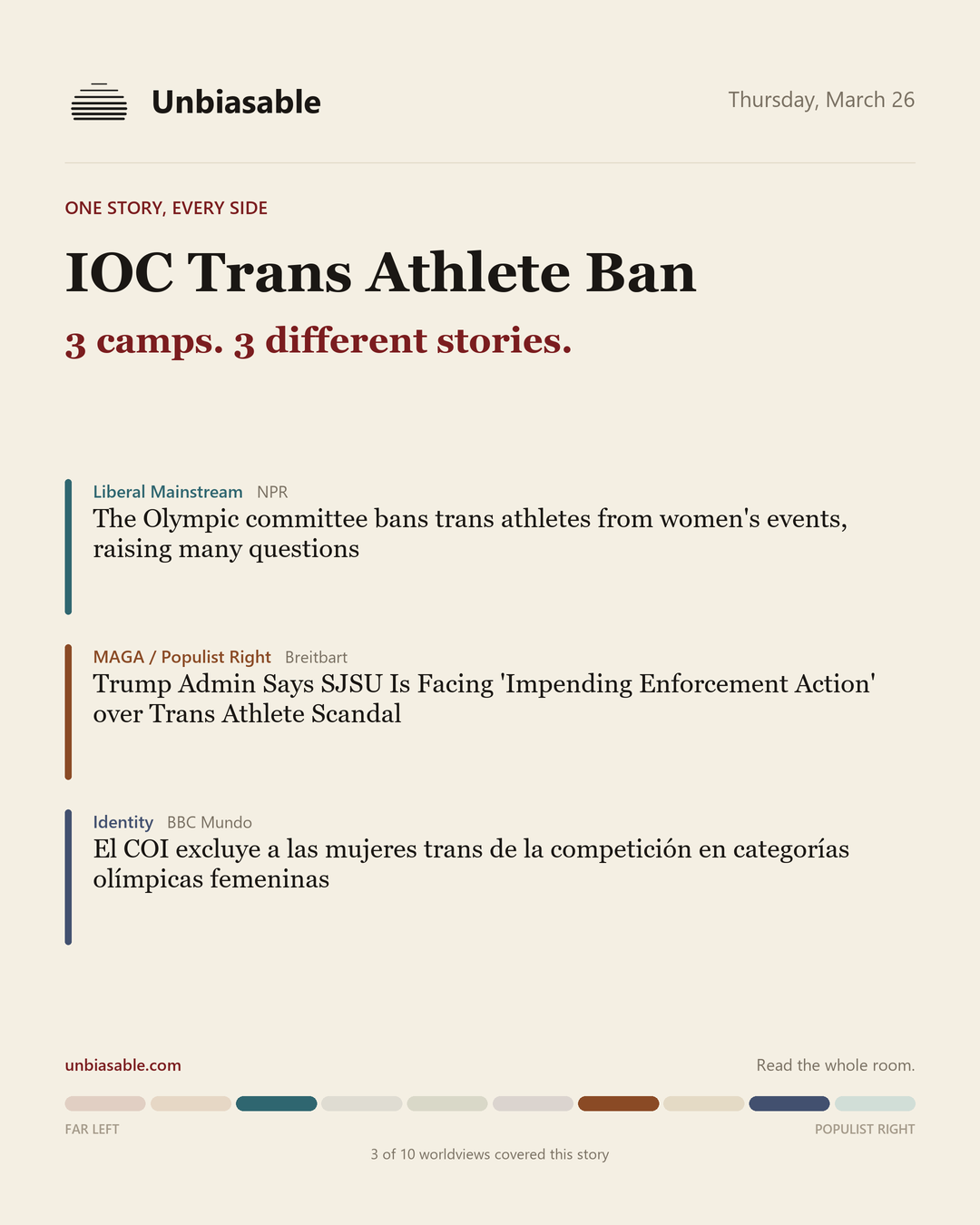
Liberal“The Olympic committee bans trans athletes from women's events, raising many questions”NPR
“It doesn't just affect the people that are being tested, but it affects all women athletes”
: Leads with the scientific complexity of SRY gene testing: false positive risk from lab contamination, cases of women who test positive for SRY but whose bodies cannot respond to testosterone and thus gain no athletic benefit, and the potential chilling effect on all women athletes if those uncertain they can pass the test forgo sport entirely [101]. Pennsylvania State kinesiology professor Jaime Schultz: "It doesn't just affect the people that are being tested, but it affects all women athletes" [101]. The IOC's claim to base the policy on "scientific evidence" is examined and found significantly more complicated than stated.
MAGA“Trump Admin Says SJSU Is Facing ‘Impending Enforcement Action’ over Trans Athlete Scandal”Breitbart
“conspired to have a member of the opposing team spike her in the face”
: Uses the IOC announcement as context for the SJSU enforcement action. Focuses on allegations that SJSU coaching staff was told not to inform female players that Blaire Fleming was male, that seven all-women teams forfeited rather than compete, and that after a female volleyball player joined a Title IX lawsuit, the male athlete "conspired to have a member of the opposing team spike her in the face" [212]. The school president's statement prioritizing "LGBTQ members of our community" over the enforcement demands is quoted as evidence of institutional capture by "radical ideology" [212]. The IOC ban is treated as scientific consensus that resolves rather than complicates the question.
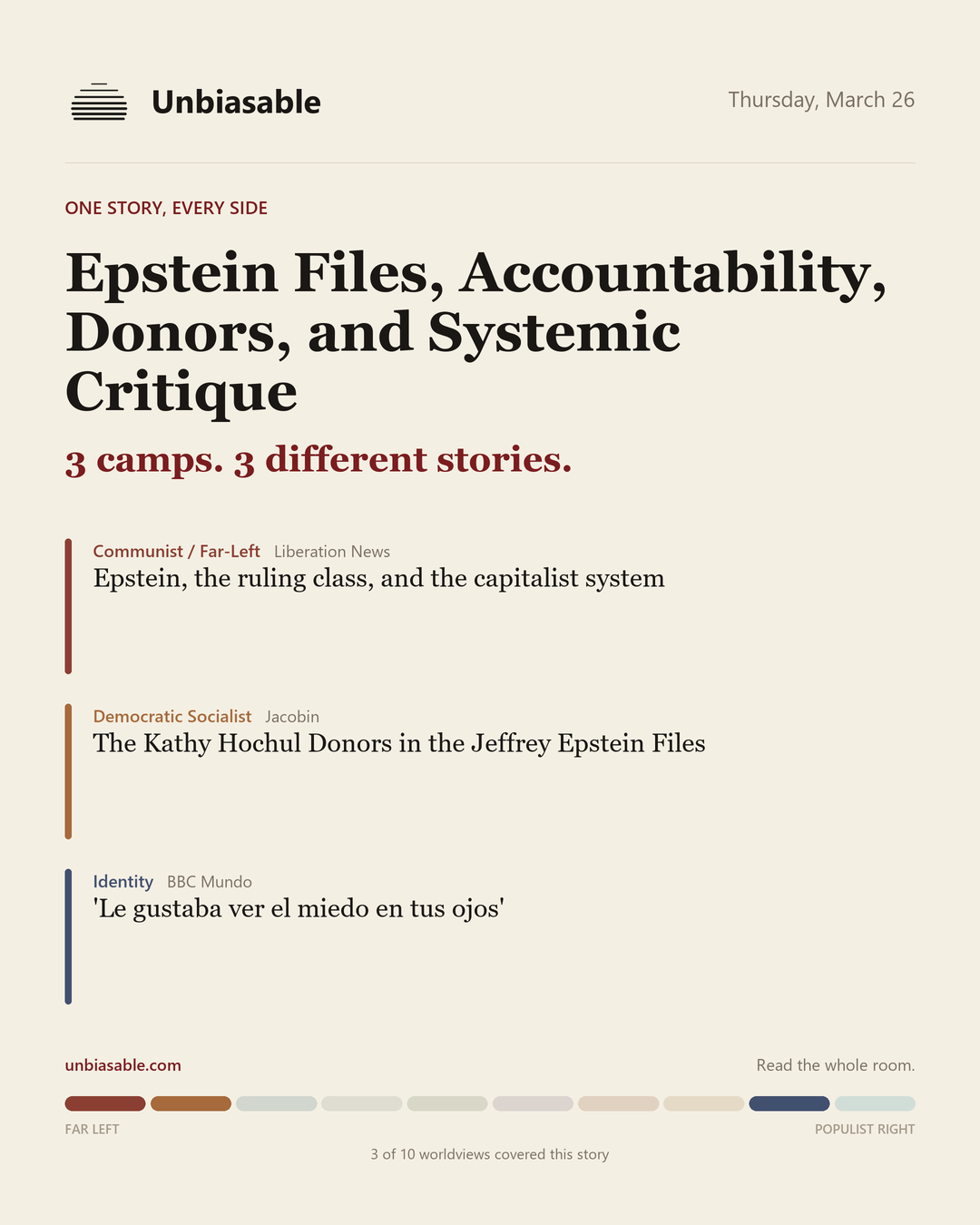
Epstein Files, Accountability, Donors, and Systemic Critique
3 source groups in today’s recordNo relevant coverage found from Liberal MainstreamEstablishmentLibertarianReligious Right
How each side framed it
Far Left“Epstein, the ruling class, and the capitalist system”Liberation News
“the inner workings and collusion of the highest echelons of the global capitalist class”
: The Epstein files expose "the inner workings and collusion of the highest echelons of the global capitalist class" [9]. Sexual exploitation of the vulnerable is not exceptional criminality but a "historical constant among the elite ruling class" traceable from chattel slavery to the present, the same class structure that produces imperialism produces trafficking [9]. Justice is structurally impossible under capitalism because the legal system is an instrument of the ruling class; Bondi's Judiciary Committee appearance is analyzed as deliberate theater designed to deflect from Trump [17].
Dem Soc“The Kathy Hochul Donors in the Jeffrey Epstein Files”Jacobin, Truthdig
“Epstein class”
: Concrete political accountability. Jacobin's Hochul piece is investigative: naming donors, citing email evidence, noting that Hochul has been demanding Epstein file release while refusing to tax the same billionaires named in those files [56]. The contradiction, demanding disclosure while protecting the donors implicated, is the story. Truthdig argues Democrats must be willing to prosecute the "Epstein class" as a 2028 litmus test, drawing a direct line from Obama's look forward not backward doctrine on Bush-era torture to Trump's current impunity: both choices left the door open for the next escalation [63].
Meta and YouTube Found Liable for Social Media Addiction
2 source groups in today’s recordNo relevant coverage found from CommunistDemocratic Socialist
How each side framed it
Center-Right“Meta and YouTube at Fault for Social Media Addiction, Jury Finds”The American Conservative
“addiction machines”
: Straightforward news report noting the verdict and characterizing plaintiffs' lawyers' claim that features like infinite scroll were "addiction machines" [160]. The framing is descriptive rather than ideological; the American Conservative's interest in this verdict aligns with its broader suspicion of tech companies' unchecked social influence.
Florida Special Elections, Democrats Flipping Republican Territory
1 source groups in today’s record
How each side framed it
Libertarian“Trump's Home District Elects a Democratic Representative in Florida Special Election”Reason
“repackaging Trump's big-government policies”
: Reports the structural significance with appropriate skepticism, Palm Beach County went narrowly for Kamala Harris in 2024, so the seat is not as deep-red as CNN characterized it; Democrats held the seat from 2012 to 2022 [164]. But Reason frames the consistent pattern (24+ flips, zero losses) as evidence of deteriorating Trump approval on economic and foreign policy grounds, and argues Democrats could capitalize but risks "repackaging Trump's big-government policies" rather than offering real alternatives [164].
The 1933 St. Louis nut-shelling strike by Black women workers, used to trace a direct lineage from historical labor organizing to the present moment; the framing argues that cross-racial working-class solidarity defeated not just a single employer but a system. Only the Communist press covered a labor history story as present-tense political instruction. [2]
4,000 meatpackers at JBS Swift in Greeley, the largest meatpacking strike in the US since the 1950s, receiving no coverage from any other ideological camp despite its historical scale. WSWS reporters distributed materials in Creole, Spanish, French, English, and Somali. [32]
Riverside County Sheriff Chad Bianco (a former Oath Keepers member) obtained three search warrants to physically seize ballots from a November 2025 referendum that passed statewide 7.5M-4.1M; framed as a preview of election-interference tactics ahead of 2026 midterms. Only WSWS covered the seizure at all. [33]
Emil Michael, Pentagon undersecretary for research and engineering, holds millions in Perplexity AI stock while driving the decision to blacklist Anthropic from government contracts, the same Anthropic whose AI model is running inside the Project Maven targeting system being used in Iran. The financial conflict-of-interest story received no coverage outside Jacobin. [51]
Hundreds of thousands marched in Buenos Aires and dozens of other cities on the 50th anniversary of the 1976 coup; Milei's government released a revisionist video attempting to rehabilitate the junta. Covered by WSWS and BBC Mundo; invisible elsewhere. [36]
The only outlet to frame the Iran war primarily as a federal budget question: $200B Pentagon request plus $87B in interest = $300B, against $39 trillion in existing national debt. Defense Secretary Hegseth's contribution to the fiscal debate: "Obviously, it takes money to kill bad guys." [162]
X's product head rolled out country-of-origin labels revealing that high-follower "MAGA Patriot" accounts posting racist content are predominantly based in Nigeria and Pakistan, monetizing American political polarization. Musk paused the revenue-sharing fix that would have disincentivized the accounts, apparently because it would also hit pro-Musk foreign accounts. Only Reason covered the internal X conflict. [165]
Religious Right
“Sentences to Death for Following Jesus, She Now Believes Iran's Spiritual Chains Are Breaking”
CBN
A former Iranian prisoner sentenced to death on apostasy charges calls the US-Israel military campaign the beginning of an Iranian spiritual awakening and praises Trump and Netanyahu. The eschatological framing of the war as providential, "a sheepdog for the Lord" in one interviewee's words, appears exclusively in Evangelical coverage. [288]
Sen. Thom Tillis (R-NC) publicly calling Stephen Miller "a big problem in this administration from the beginning" and saying he has "outsized influence over the operations of the cabinet." The Republican-on-Republican critique was covered prominently by Black American media and largely absent from the center's horse-race coverage. [303]
The US voted against a UN resolution on slavery reparations, described by theGrio as "a slap in the face to Black Americans", with no coverage in other ideological camps despite its direct relevance to ongoing reparations debates. [328]
The only outlet to frame the TSA callouts as a labor action, "the thinnest of veneers that provides the officer with enough plausible deniability", rather than a consequence of Democratic obstruction or a symptom of government dysfunction. The wildcat framing situates the workers as political agents rather than victims of the shutdown. [54]
A profile of an activist who transitioned from progressive causes to becoming a prominent anti-ICE protester connected to the Portland demonstrations, tracking the radicalization process in real time during the DHS enforcement period. Only The Free Press covered this individual story as a cultural phenomenon. [188]
The Interior Department paid TotalEnergies nearly $1 billion to cancel offshore wind leases the company wasn't using, in exchange for oil and gas investments it was already making. Described by former BOEM head Elizabeth Klein as "a backdoor deal done with zero transparency." No coverage outside Truthdig. [65]
Minnesota escalated its fight with the Trump administration over evidence in the Good and Pretti killings by filing a federal lawsuit; BCA agents were "physically blocked from entering the scene" after obtaining a judicial warrant; the DOJ asked Minnesota to share its evidence with the federal government while refusing to share federal evidence in return. Only Truthdig covered the lawsuit directly. [66]

 “47 years of hybrid war against Iran”
Liberation News, WSWS
“47 years of hybrid war against Iran”
Liberation News, WSWS

 “The Countdown to a Ground War”
The Atlantic, NPR
“The Countdown to a Ground War”
The Atlantic, NPR