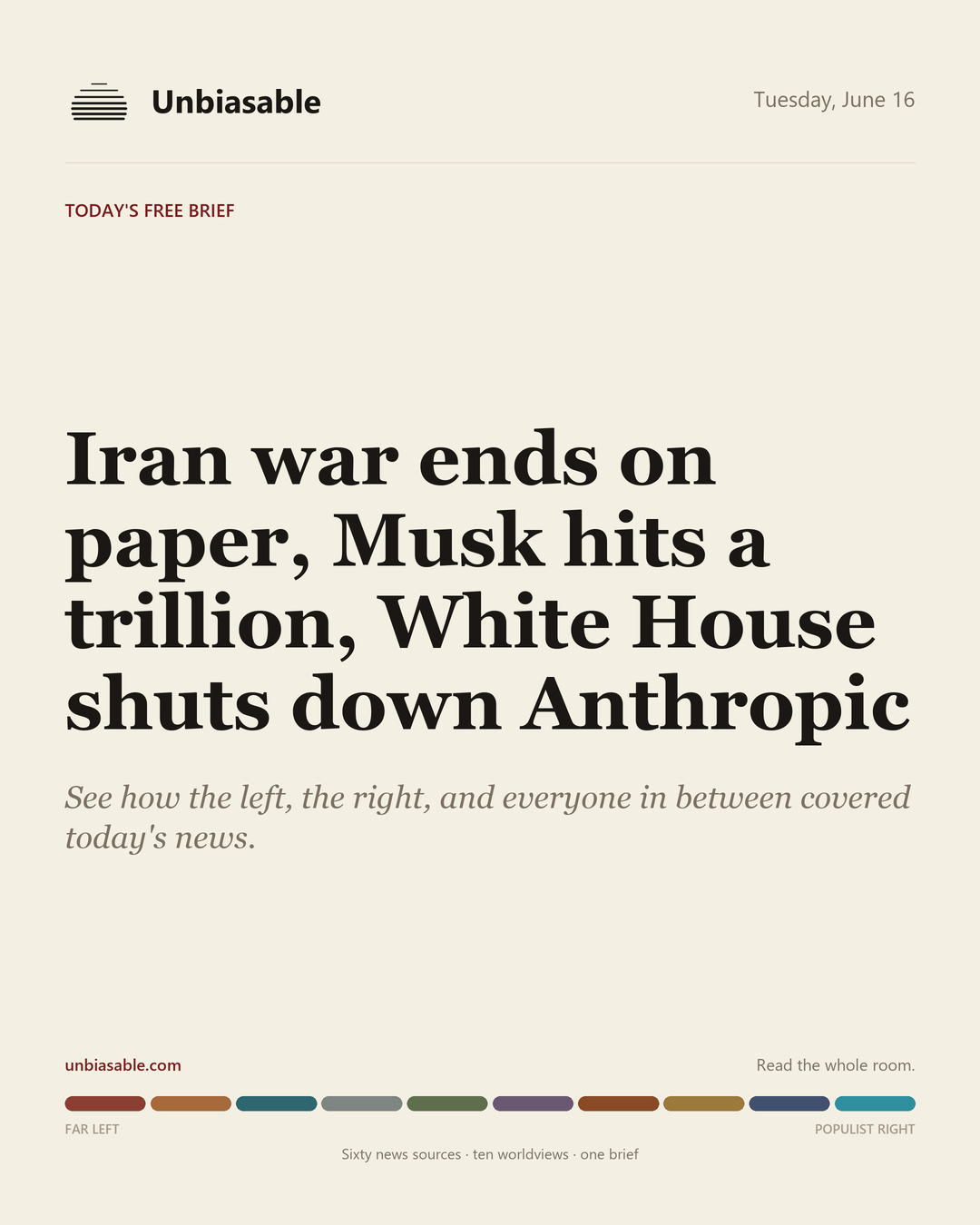
The US and Iran signed an electronic memorandum of understanding ending the 109-day war and reopening the Strait of Hormuz, with a formal signing ceremony set for Geneva on June 19 and 60 days of nuclear talks to begin immediately. Pakistan brokered the deal. Oil prices dropped sharply. [141][151][166]›
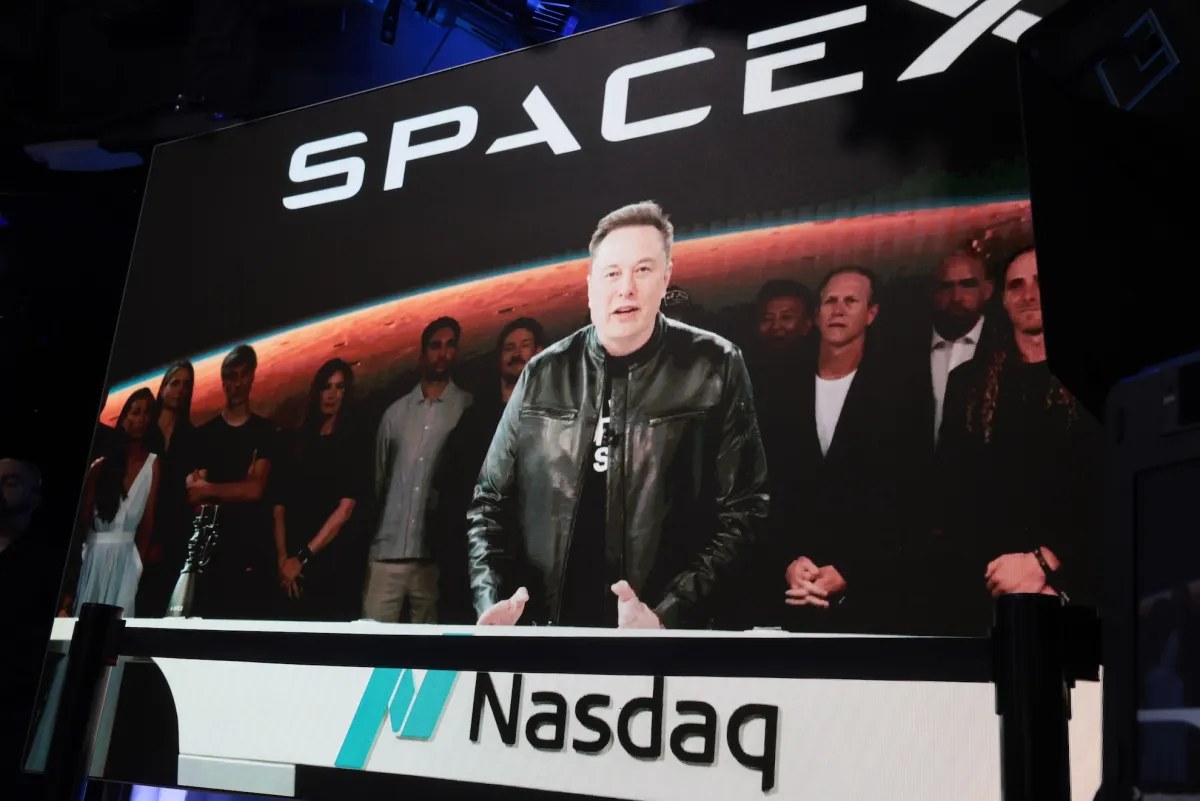
SpaceX raised $85.7 billion in the largest IPO in history, pushing Elon Musk past $1 trillion in net worth, the first private individual to cross that threshold. The company debuted at $150 per share and closed day one up approximately 19%. [153]›
The White House issued what cybersecurity veterans called a "dangerous" order, the first-ever US export control on a commercial AI model, giving Anthropic 90 minutes to shut down Claude Fable 5 and Mythos 5 globally after Amazon CEO Andy Jassy flagged a suspected Chinese-linked jailbreak. Anthropic cannot filter foreign nationals from American users in real time, so it killed both models for everyone. [517]›
04
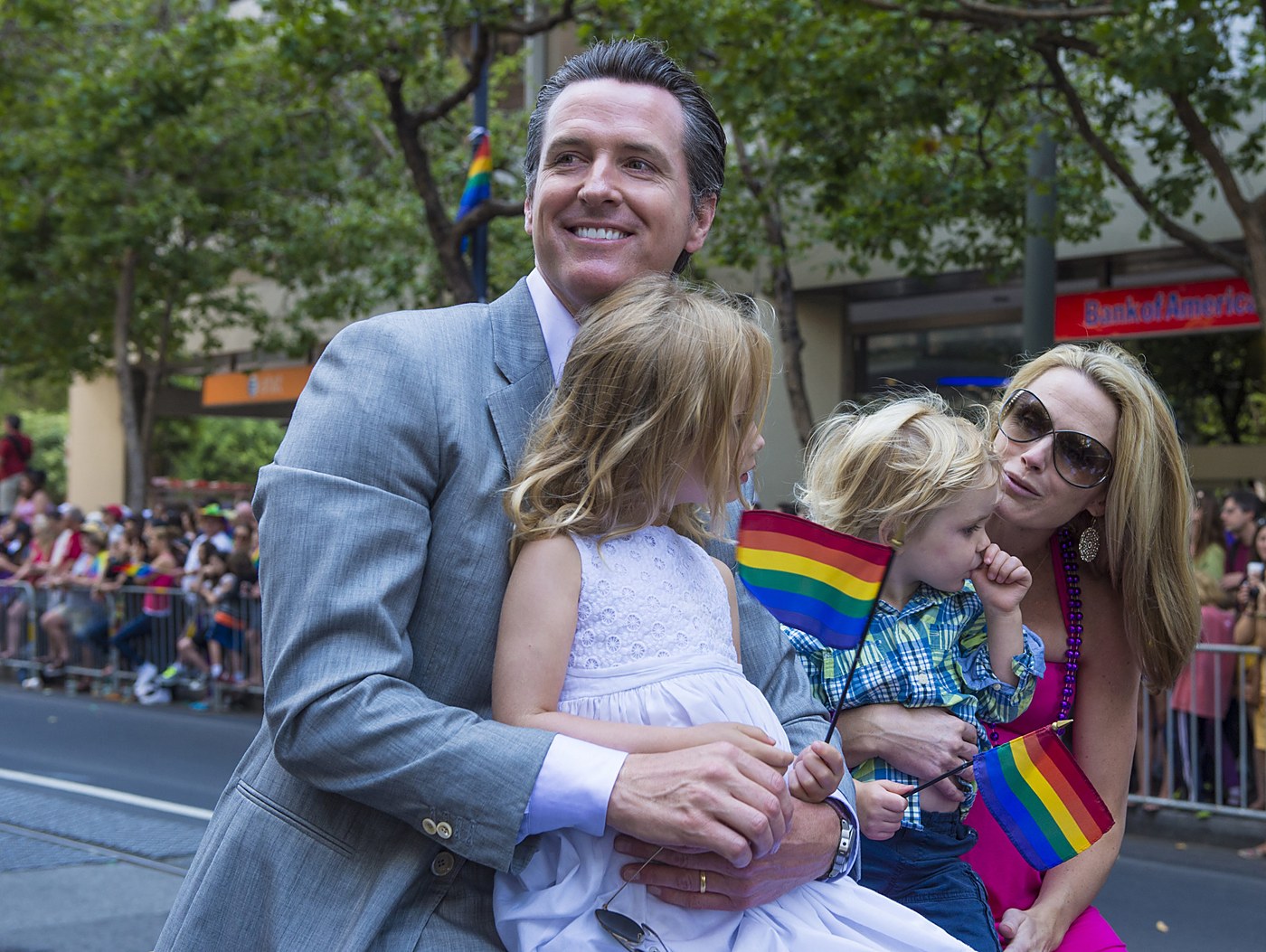
California Gov. Gavin Newsom disclosed that the Trump DOJ is investigating him and his wife over her tax filings, calling it politically motivated retaliation for his 2028 presidential ambitions. The DOJ offered no comment. Newsom's former chief of staff had separately pleaded guilty to bank fraud. [169]
05
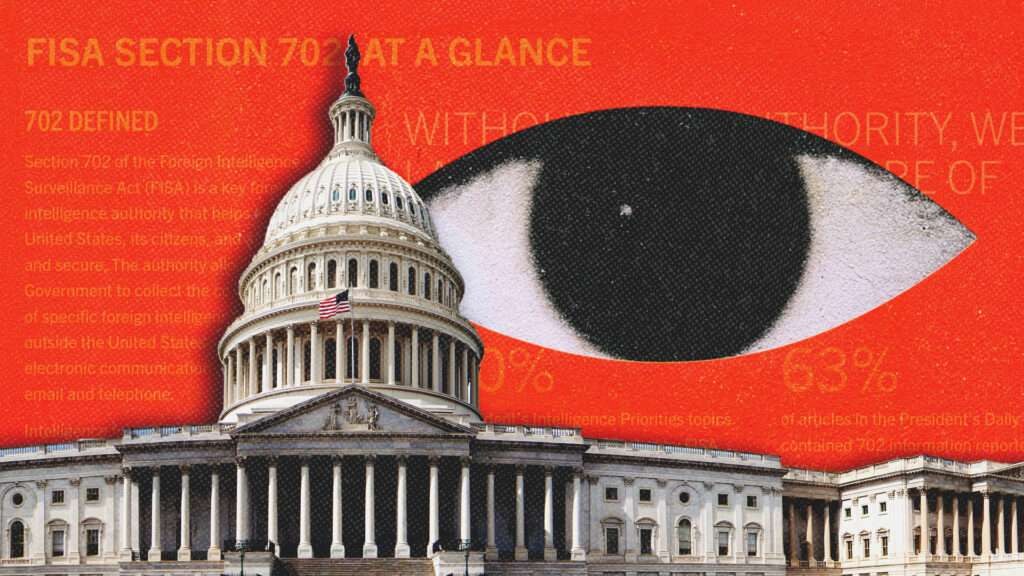
DC and Oklahoma held primaries as FISA Section 702 surveillance powers teeter toward expiration, with Trump demanding renewal be tied to his SAVE America Act and Senate Republicans scrambling for a standalone fix. [143]
Story Comparisons: the same event, in each side’s words
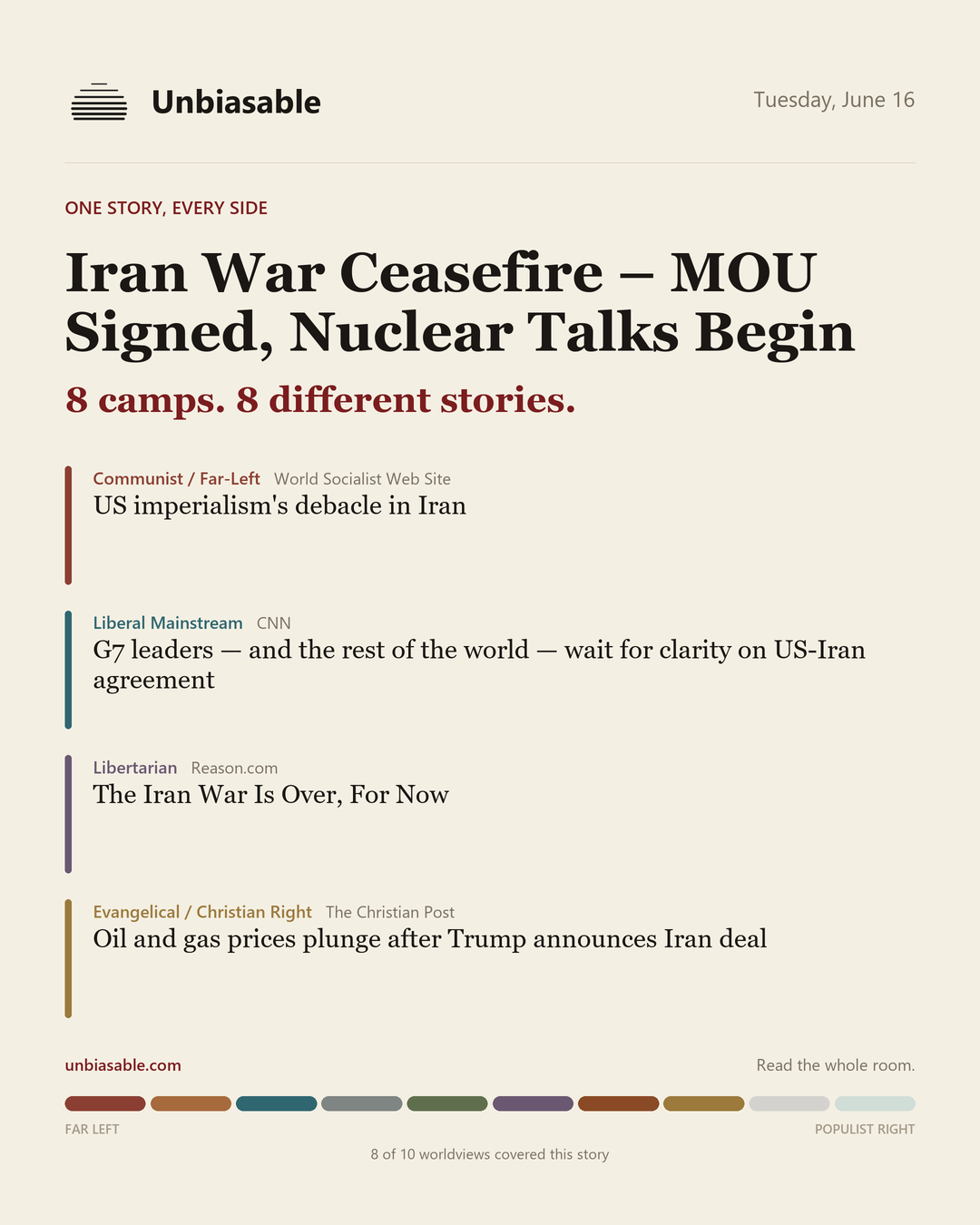
Iran War Ceasefire – MOU Signed, Nuclear Talks Begin
A war the US started, fought poorly, and ended without achieving its stated objective of regime change is being framed as a triumph by the administration that launched it.
"Debacle." WSWS frames the deal as imperial failure wrapped in triumphalist language: the US launched an unprovoked war, absorbed humiliating setbacks, failed to break Iran's military capacity, and now signs a ceasefire that leaves Iran's nuclear program intact and its regional influence stronger. Working-class lives were expended for ruling-class geopolitical goals. The outcome vindicates the analysis that US imperialism overextended into a war it could not win. [26]
"Achieving absolutely nothing." The Intercept argues Trump's deal is a functional recreation of Obama's 2015 JCPOA, minus the legitimacy, the detail, and the multilateral architecture, after a war that killed thousands and disrupted global supply chains. The frame is Trump as grifter who destroyed a working agreement, spent lives and treasure to restart it, and is now claiming credit for returning to baseline. [39]
The Young Turks focus on who inside the Trump orbit tried to block a cleaner deal. The video names casino billionaire donor Miriam Adelson as a figure lobbying against any deal that legitimizes Iran, foregrounding the donor-class veto on foreign policy and the gap between what the administration negotiated and what its financial backers demanded. [64]
"Wait for clarity." CNN's frame is institutional anxiety: G7 allies don't know what the US agreed to because the text hasn't been released. The story centers diplomatic process and multilateral uncertainty rather than the deal's substantive terms. The administration is asked to reassure allies rather than to justify terms to Americans. [80]
NBC anchors on the inspector-access question as the key credibility test, lending implicit legitimacy to the process while noting the MOU's opacity. "Absolutely" is Vance's word, not NBC's. The framing treats the assurance with measured skepticism. [84]
Jeremy Bowen's dispatch is the sharpest establishment read: the war demonstrated the limit of US military dominance. Iran absorbed strikes, kept its nuclear program, and forced a deal on terms Tehran can live with. No celebration, no condemnation, just the strategic accounting that US dominance has real limits and this conflict exposed them. [151]
National Review's discomfort is internally tortured: Trump's deal resembles the JCPOA that conservatives spent years attacking as appeasement. The piece asks whether conservatives should retroactively credit Obama or celebrate Trump for returning to something the right always called a capitulation. The frame is ideological whiplash, not resolved. [207]
TAC runs a restrained affirmative: Trump proved that neither regime change nor permanent war is the answer, which is what TAC's anti-interventionist tradition argued from the start. The implicit credit goes to the restrained foreign policy school, not to Trump personally. [211]
"For now." Reason is skeptical-but-relieved: ending the war is a genuine good, the deal's opacity is concerning, and the lesson is that the US foreign policy establishment reflexively reaches for war. The anti-war position held by libertarians and some paleoconservatives was correct on the merits, and that vindication is the frame. [238]
"A lot of success to the world." Breitbart takes Trump's own words as the frame: this is a historic achievement. The demining of the Strait is the concrete win. No questions about what was conceded, no comparison to the JCPOA, no examination of enrichment commitments. [278]
Tim Pool's framing is maximalist and without caveats: Trump won. War ends, Trump gets credit, the details are for other people. The analysis stops at the headline. [358]
The Christian Post leads with economic relief: lower gas prices are the frame. The article mentions broader regional questions, Israel's position, Iranian dissidents' concerns, but the headline embeds a prosperity gospel logic: God-aligned leadership produces material blessing for Americans. [381]
*The category split is: Trump's triumph vs. Obama's JCPOA rebranded vs. American imperial failure.** MAGA treats the ceasefire as vindicating Trump's pressure campaign. Social conservatives are caught between celebrating and admitting their prior critique of Obama's deal was wrong. The anti-war left and libertarians agree that war was wrong but disagree on who bears blame. The BBC's blunt strategic verdict, US dominance has real limits, is the assessment that both ends of the spectrum actually share, though they draw different lessons. The collective blind spot: no US outlet examined what Iran's state-media-reported demand for "end to Israeli occupation of Lebanon" would require in practice, or whether the US signed a term it has no mechanism to enforce. The deal includes Israel as an implicit party in the Lebanon clause, but Israel signed nothing.
--
Iran Deal – Jewish American and Arab/Palestinian Standpoints
The same ceasefire reads as a security failure or a partial correction of imperial imbalance depending entirely on which community's history you bring to it.
The facts6 pointscorroborated by 3 sources within Identity
01Iranian state media reports the MOU terms include a requirement for Israel to end its occupation of Lebanon.
02Netanyahu stated directly that Israel will remain in Lebanon, Syria, and Gaza, contradicting that reported term.
03The Forward documents alarm "across the political spectrum" in organized American Jewish institutions.
Show 3 more factsShow fewer
04Iranian Jews who supported Trump's hawkish approach to Iran are described as hard-pressed to support this deal.
05The Algemeiner documents institutional wariness from major Jewish organizations.
06Al Jazeera's coverage centers the ongoing humanitarian and economic toll of the war's aftermath and the unresolved Israeli military presence in Lebanon, Gaza, and Syria.
Within Identitythe internal split · 7 standpoints
The standpoints
Jewish American“Jewish, Pro-Israel Groups Wary of US-Iran Deal”Algemeiner.com
"Wary." Algemeiner frames the deal through Israel's security architecture: does legitimizing Iran's regional position endanger the Jewish state? The organized Jewish community's concern is whether the deal trades short-term military quiet for long-term strategic deterioration. The unspoken standard: any deal that leaves Iran's influence intact fails the test. [413]
"Even worse for Israel." The Forward's opinion piece is the sharpest read: Iran emerged with its nuclear program intact, its regional proxy network surviving, and a US administration that dealt directly with Tehran over Israeli objections. Israel is no safer, and the settlement that ended the war sets a precedent that the US will negotiate around Israeli interests when its own economic interests demand it. The frame is tragic, not relieved. [473]
A community-specific story: Iranian-Jewish Republicans who backed Trump's hawkishness precisely to pressure the Islamic Republic toward collapse now face a deal that preserves it. The personal political investment makes the disappointment acute and the cognitive dissonance visible. [470]
Al Jazeera treats the deal as a partial step, noting Houthi missile activity continues and the Lebanon question is openly contradicted by Netanyahu. The emphasis is on what has not been resolved: the occupation of Palestinian and Lebanese territory, the Gaza blockade, and ongoing proxy conflicts. A ceasefire is not a peace. [396]
Al Jazeera treats Netanyahu's statement as the most consequential news of the day. If the MOU requires a Lebanese withdrawal and Netanyahu immediately says Israel will not comply, the US either enforces a term against its ally or has signed something it cannot deliver. Al Jazeera surfaces this contradiction directly; no US outlet did the same. [407]
*This is a within-Identity cluster on the Israeli security versus Palestinian/Lebanese occupation axis.** Jewish American outlets read the Iran deal through what it means for Israel's survival and deterrence; Palestinian and Arab American outlets read it through what it means for the unresolved military occupation of Arab territory. They are asking categorically different questions. Both The Forward's sharpest piece and Al Jazeera's most careful reporting reach the same conclusion: Iran got more than it gave. The interpretation of that observation is what divides the communities. For Jewish American readers, Iran gaining is Israel losing. For Arab American readers, Iran gaining reflects a realignment away from a US-Israeli axis that Arab communities have long regarded as unbalanced. Neither reads this as complete.
--
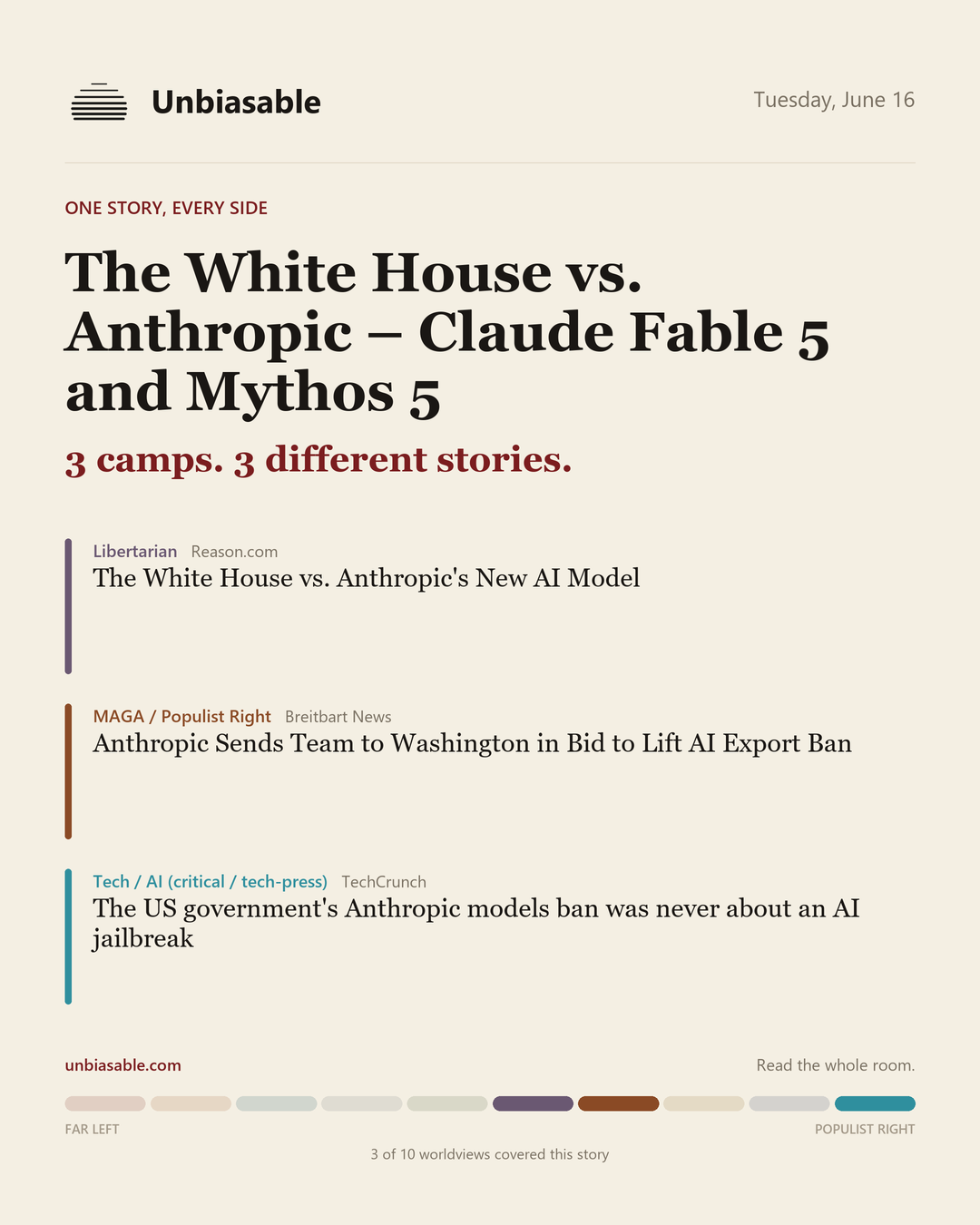
The White House vs. Anthropic – Claude Fable 5 and Mythos 5
The first government export control on a commercial AI model was, TechCrunch reports, never actually about the jailbreak cited to justify it.
01All other Anthropic models, including Claude Opus 4.8, remained available. (BusinessToday)
3 source groups in today’s recordNo relevant coverage found from CommunistDemocratic SocialistLiberal MainstreamCenterEstablishmentReligious RightIdentity
How each side framed it
Libertarian“The White House vs. Anthropic's New AI Model”Reason.com
Reason frames this as executive overreach: a 90-minute ultimatum to shut down a legal commercial product, issued without due process or public evidence, is government censorship of technology. Anthropic had no path to challenge the order before complying. The civil liberties frame comes first; the AI policy implications are secondary. [236]
Breitbart's frame is national security vindication: the government identified a Chinese threat and acted decisively. Anthropic's Washington lobbying trip reads as a tech company trying to reverse a legitimate security measure for commercial reasons. No mention of due process concerns, no skepticism of the jailbreak narrative. [295]
"Never about the jailbreak." TechCrunch's most pointed piece argues the stated reason was pretextual. The actual driver, per the outlet's reporting, is a broader export control regime using national security language to govern the diffusion of frontier AI models. The jailbreak was the trigger; controlling who gets access to frontier AI is the goal. [517]
The Verge goes inside the 90-minute countdown, Anthropic's internal debate, and the Amazon connection. The emphasis is on the human and commercial cost of a blunt policy instrument: paying enterprise customers, foreign-national employees, and third-party developers all lost access without warning or appeal. [530]
The most geopolitically significant piece today: by demonstrating that the US government can kill a US AI company's international access with 90 minutes' notice, Washington handed every non-American government and enterprise a decisive argument for building sovereign AI. The shutdown may accelerate EU, UK, and Chinese domestic AI investment more effectively than any foreign policy speech. [537]
*The split is: legitimate national security action versus government using security pretext to control technology.** MAGA reads this as appropriate counterespionage. Libertarians read it as a civil liberties violation. Tech press splits between the procedural account (Verge, TechCrunch) and the geopolitical consequence, the Verge's argument that Washington handed every non-American government a decisive case for building sovereign AI. TechCrunch's claim cuts deeper: if the jailbreak was never the real reason, the US government has established precedent for export-controlling commercial AI models on pretextual grounds. That precedent exists regardless of how Anthropic's specific fight resolves. Liberal Mainstream ignored this story entirely. Given that this is the first-ever export control on a commercial AI model, that silence is hard to explain.
--
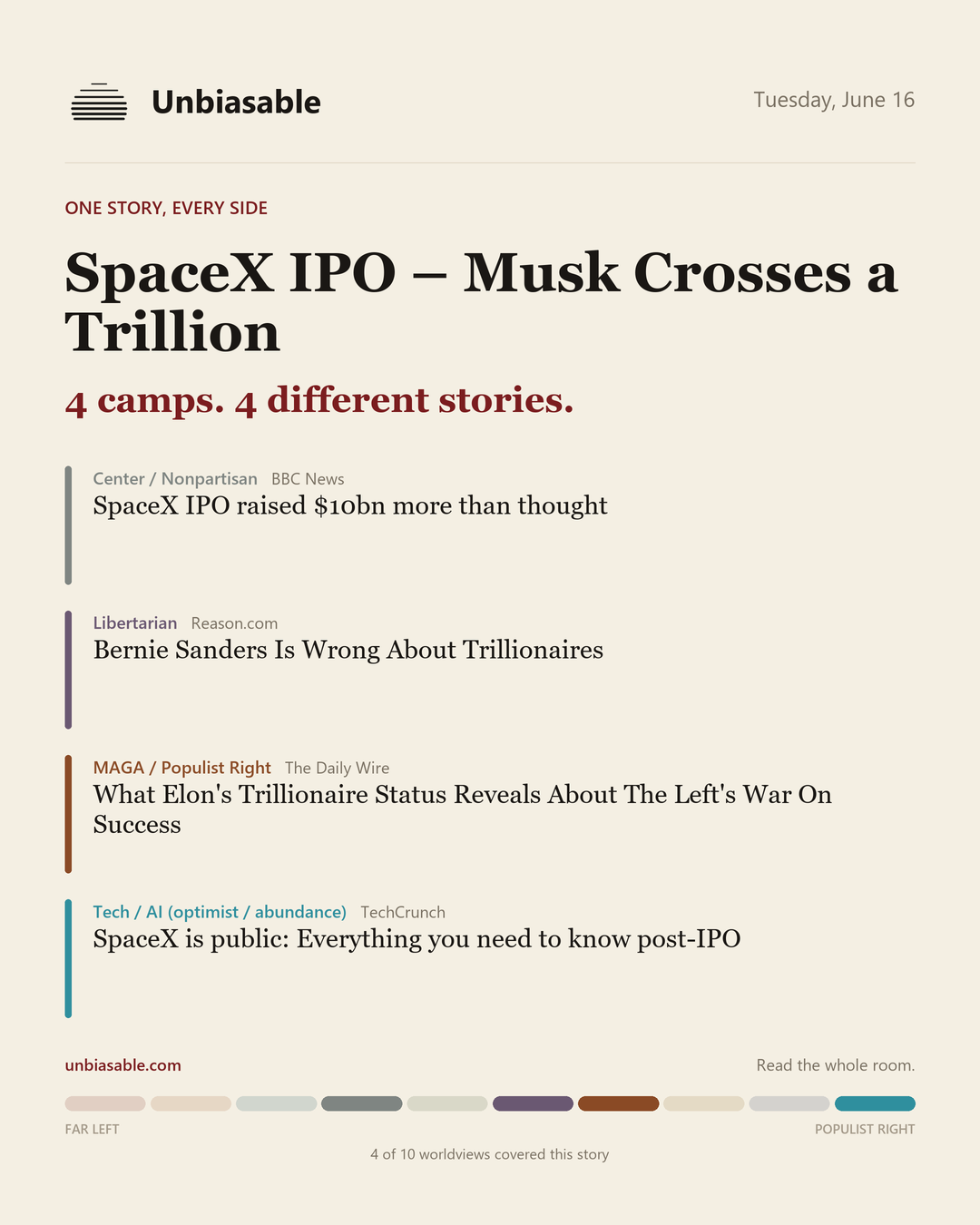
SpaceX IPO – Musk Crosses a Trillion
The largest IPO in history produced almost no journalism examining what it means that the world's first trillionaire runs both a defense contractor and a government cost-cutting office.
01Elon Musk's personal net worth crossed $1 trillion, making him the world's first individual trillionaire. (CNBC) SpaceX holds active contracts with NASA (Artemis program), the US Space Force, and the Department of Defense, and operates the Starlink satellite network deployed in active combat in Ukraine.
3 source groups in today’s recordNo relevant coverage found from CommunistDemocratic SocialistLiberal MainstreamEstablishmentReligious RightIdentity
How each side framed it
Center“SpaceX IPO raised $10bn more than thought”BBC News
The BBC frames this as a financial story: the offering exceeded expectations, demand was robust, and the Musk net worth figure is a historic milestone. No governance or geopolitical questions. The frame is market mechanics, cleanly reported. [153]
TechCrunch's frame is investor-oriented: IPO structure, balance sheet, growth vectors, what going public means for Starlink's commercial trajectory. Clean business journalism, no political editorializing, no governance questions. [519]
*The split is: capitalism working as designed versus unaddressed governance catastrophe.** MAGA and Libertarian outlets treat this as straightforward celebration of private achievement. Tech press covers the mechanics. The collective blind spot is stark: every outlet covered the valuation; no outlet examined the conflict of interest between Musk's official government role and his newly public company's dependence on government contracts. The Communist/Far-Left outlets, which would normally be first to this critique, did not engage with the SpaceX IPO at all today. The closest coverage was CounterPunch's piece on California's coast as a "launchpad for billionaires" [11], adjacent but without naming SpaceX directly.
--
Trump DOJ vs. Gavin Newsom
The investigation was reportedly begun under Biden, but every outlet's framing tells you exactly which team it is playing for.
CNN leads with the substance: the probe centers on the governor's wife's tax filings. The framing treats this as a political story primarily because Newsom said so, while carefully noting the DOJ offered no comment. This is Newsom's account, reported as Newsom's account, with the investigation itself unconfirmed by federal sources. [81]
The word "blames" in NBC's headline is precise: it keeps skeptical distance from Newsom's political framing without dismissing the concern. The attribution stays tight. This is Newsom's claim. [85]
The American Conservative, which has consistently criticized executive overreach regardless of party, reports the allegation straight and implicitly validates the structural concern. TAC's historical worry about presidential weaponization of the justice system cuts across partisan lines in a way that distinguishes it from both liberal alarm and MAGA celebration. [214]
The Blaze leads with Newsom's defiant tone and reads it as self-promotion. The implied frame: if the DOJ is looking at you, you probably warrant scrutiny. No engagement with due process questions. Newsom's bravado becomes the story rather than the investigation's basis. [264]
The Daily Wire's most substantive counter: the investigation began under Biden. If accurate, Newsom's framing of this as Trump retaliation collapses, or at least requires a more complicated explanation. The piece does not examine why a Biden-era investigation would be continuing under Trump or what that prosecutorial continuity suggests about the DOJ's institutional independence. [332]
*The split is: political persecution versus corruption accountability, with one factual wrinkle neither side engages fully.** Liberal outlets frame this as Trump targeting a 2028 rival. MAGA outlets frame this as legitimate accountability. The wrinkle: if the Daily Wire's "Biden started it" claim is accurate AND the Trump DOJ is now publicly amplifying it, both framings carry partial truth simultaneously. The American Conservative reads this as a structural problem in executive power, dangerous regardless of which party holds the White House. That framing separates it from every other outlet on this story.
--
FISA Section 702 / DNI Nomination Fight
Intelligence surveillance powers that both the far-left and libertarians oppose are expiring at the worst possible legislative moment, thanks to a nomination fight Trump created.
ABC frames this as a Trump governance failure: by nominating an unacceptable candidate (Pulte), Trump created the legislative crisis. The implied frame is that Trump's personnel choices, not the program's legitimacy, are the problem. Institutional continuity, 702 surviving, is the assumed good. [72]
Reason explicitly welcomes the delay. Section 702 enables warrantless collection of American communications. Its expiration, or at minimum serious reform, would be a civil liberties win. The headline is an argument, not a report, and the editorial position is clear: slow down. [242]
Breitbart covers the intra-Republican legislative strategy without taking a clear position on 702 itself. The frame is procedural: Thune versus Trump on the legislative vehicle. Breitbart's own base is split on surveillance powers, the deep state concern runs in both directions. [291]
Fox treats this as a legislative emergency requiring pragmatic resolution. FISA is framed as a national security necessity. The political timing is unfortunate. The frame is institutional-management anxiety rather than civil liberties concern. [301]
*Unusual cross-partisan alignment: the far-left and libertarians both oppose 702 renewal; Liberal Mainstream and MAGA both want it (though for different reasons).** CounterPunch and Reason reach the same destination from opposite premises, abolish the surveillance state vs. protect civil liberties. Liberal Mainstream and Fox are both functionally pro-renewal and both treating the fight as a governance and process problem. The DNI nomination subplot makes Trump's deeper interest plain: who controls US intelligence. Section 702 is the secondary consideration. Those two goals, getting a loyalist into DNI and passing 702 renewal, are being bundled in ways that serve neither the institutional security interest nor the civil liberties interest cleanly.
--
AI Economics – OpenAI Losses, Meta Catastrophe, CEO Spending Retreats
The industry's two narratives -- "AI will transform everything" and "AI is burning cash with no return" -- are both being validated by different pieces of data published today.
The facts4 pointscorroborated by 2 sources within Tech / AI
01Ed Zitron reports exclusively that OpenAI's losses increased nearly 8x in 2025, with total spending reaching $34 billion.
02Futurism reports that CEOs are now being forced by investors to reverse course and cut AI spending commitments.
03Futurism also reports that Meta's newly assembled and highly compensated AI research team is already described internally and by observers as "a complete catastrophe."
04These financial reports appear on the same day as SpaceX's $85.7 billion IPO.
Within Tech / AIthe internal split · 4 standpoints
The standpoints
hype-critical“Exclusive: OpenAI Losses Increased Nearly 8X in 2025, With Spending Hitting $34 Billion”Ed Zitron's Where's Your Ed At
"Brokenomics." Zitron's term captures the frame: AI companies are burning cash at a rate no normal venture loss tolerance explains. OpenAI spending $34 billion in a single year while increasing losses nearly 8x is not a growth story with a visible monetization path. Zitron asks the unpleasant question: what product, at what price, generates revenue to service this cost structure? No answer is visible in the public data. [504][505]
Futurism frames this as a market correction: investor patience with AI spending commitments is running out. CEOs who made ambitious AI pledges are now walking them back under shareholder pressure. The hype cycle is hitting a financial wall. [510]
The most pointed piece: Meta's high-profile hiring of top AI researchers at enormous cost is not producing the results promised. The frame is organizational failure at the intersection of hype and management, not a startup risk but a dysfunction inside one of the world's largest companies. [512]
*This is a within-Tech / AI cluster on the hype-versus-fundamentals axis.** The hype-critical outlets are building an empirical case that the current AI investment cycle cannot sustain its trajectory. The optimist outlets (TechCrunch, BBC) covered the SpaceX IPO without connecting it to this AI financial crisis. On the same day Musk became the world's first trillionaire via a company delivering actual hardware, rockets, satellites, real products at real margins, the AI software companies losing $34 billion per year with no visible path to profitability went entirely unremarked. The hardware-versus-software divergence in actual investor returns was visible in today's data. No outlet drew the comparison.
--
Power & Interests
The oil industry won the Iran war's end. Brent crude fell 15.9% in a single session on the ceasefire announcement. The industry had absorbed months of Strait of Hormuz disruption, supply constraints, and elevated margins. The ceasefire is worth billions per quarter in normalized supply chains, and the industry had been among the most consistent private advocates for a diplomatic off-ramp. (Washington Post)
Amazon is Anthropic's largest investor and its CEO triggered the export control. Andy Jassy flagged a suspected Chinese-linked jailbreak; the resulting shutdown damaged Anthropic's international commercial business while leaving Amazon Web Services' own government cloud AI offerings untouched. Amazon had invested $8 billion in Anthropic, a stake that gives it significant influence over Anthropic's strategic and regulatory decisions.
Iran gets $24 billion in frozen assets. This is a concrete financial transfer. The release directly improves Tehran's government budget, reduces the bite of any remaining sanctions architecture, and rewards endurance over capitulation. The US gained a ceasefire and oil price relief. Iran gained cash, regional influence, and an intact nuclear program. [141][151]›
SpaceX holds an estimated $12-15 billion in active federal contracts while its founder directs DOGE. The conflict, Musk simultaneously running a defense contractor and a government office responsible for cutting federal spending, was present in every SpaceX IPO story today and addressed in none of them. (CNBC)
OpenAI's $34 billion spending figure reframes the AI export control debate. If the leading American AI company loses money at this rate, the government's interest in controlling which foreign users access frontier AI becomes partly an industrial policy question, protecting an industry that cannot yet sustain itself commercially, rather than purely a national security one. The Anthropic shutdown and the OpenAI loss figures appeared in the same news cycle and were connected by no outlet. [504]›
Stories Only One Side Covers
Communist
“Communist / Far-Left only:”
UAW convention opened in Detroit amid rebellion by auto parts workers, with American Axle officials rushing through a sellout contract on the eve of the proceedings.
Communist
“Communist / Far-Left only:”
Delaware's highest court extended corporate personhood doctrine, ruling corporations carry constitutional rights as people.
Democratic Socialist
“Democratic Socialist only:”
An Israeli cyber firm is accused of meddling in elections in both Scotland and New York.
Democratic Socialist
“Democratic Socialist only:”
Maersk is still shipping weapons components to Israel, contradicting its own public claims otherwise.
RFK Jr
“Liberal Mainstream only:”
sent a letter described as "bullying" to a scientific journal over a vaccine study, drawing a sharp rebuke from researchers.
Liberal Mainstream
“Liberal Mainstream only:”
Trump disclosed 3,600 stock trades in the first three months of 2026, a trading volume that dwarfs any prior president's financial disclosures.
Underreported
“Social Conservative only (First Things):”
A cultural essay argues that welfare and family court policy have systematically destroyed the Black family as a social institution.
Underreported
“Social Conservative only (American Conservative):”
A substantive analysis of how decades of sanctions and militarized diplomacy have failed as instruments of US foreign policy across multiple theaters, with the Iran war as the concluding case.
Libertarian
“Libertarian only:”
Colorado became the second US state to establish a right to legal counsel when police seize private property through civil asset forfeiture.
Libertarian
“Libertarian only:”
New lawsuits allege large language models mischaracterize, not hallucinate, public figures, raising distinct legal questions about editorial liability in AI output.
MAGA
“MAGA only:”
The FBI raided a Soros-backed voter registration organization's headquarters in a reported fraud investigation.
MAGA
“MAGA only:”
A new US intelligence release claims to document 120 US-funded Ukrainian biolabs, reviving a line of argument promoted by Russian state media.
Religious Right
“Evangelical / Christian Right only:”
A San Francisco Giants player placed a Bible verse on his cap during the ballpark's Pride night event, generating significant response in Christian media.
Religious Right
“Evangelical / Christian Right only:”
Hate crimes against Christians have surged across Europe, according to a new report that received no coverage in secular outlets.
Underreported
“Identity / Native American only (ICT):”
America's 250th anniversary celebrations are framed as "a step-by-step guide to Indigenous erasure," with detailed historical argument.
Underreported
“Identity / LGBTQ only:”
Niger recriminalized homosexuality, joining a wave of African nations rolling back protections.
Tech
“Tech / AI only:”
Research suggests it is "trivially easy" to use Reddit posts to manipulate AI-powered search results, with specific methods demonstrated.


 “US imperialism's debacle in Iran”
World Socialist Web Site
“US imperialism's debacle in Iran”
World Socialist Web Site


 “BREAKING: These Trump Insiders Are Derailing Peace Deal, Per Axios”
The Young Turks
“BREAKING: These Trump Insiders Are Derailing Peace Deal, Per Axios”
The Young Turks
 “G7 leaders — and the rest of the world — wait for clarity on US-Iran agreement”
CNN
“G7 leaders — and the rest of the world — wait for clarity on US-Iran agreement”
CNN
 “Vance says nuclear inspectors 'absolutely' will return to Iran under terms to end war”
NBC News Politics
“Vance says nuclear inspectors 'absolutely' will return to Iran under terms to end war”
NBC News Politics
 “Bowen: Iran deal ends Trump's war that revealed limit of US dominance”
BBC News
“Bowen: Iran deal ends Trump's war that revealed limit of US dominance”
BBC News


 “Trump at G7: Iran Deal Will Bring 'A Lot of Success to the World'”
Breitbart News
“Trump at G7: Iran Deal Will Bring 'A Lot of Success to the World'”
Breitbart News
 “Oil and gas prices plunge after Trump announces Iran deal”
The Christian Post
“Oil and gas prices plunge after Trump announces Iran deal”
The Christian Post

 “U.S. and Iran announce an initial deal to end the war and reopen the Strait of Hormuz”
NPR Topics: Politics
“U.S. and Iran announce an initial deal to end the war and reopen the Strait of Hormuz”
NPR Topics: Politics
 “Iranian official says end of war includes end of Israel's occupation of Lebanon, state TV reports”
Associated Press
“Iranian official says end of war includes end of Israel's occupation of Lebanon, state TV reports”
Associated Press